134: DOCTOR
Added 2024-01-06 23:35:00 +0000 UTCI go first. I want to see more of the colony.
“So,” I ask over radio as Max leads me from the vehicle bay towards a nearby dome while the Friend tries to impress upon Hive the importance of disinfecting the vehicle bed we’d been in, “what’s this Dr Kim like?”
“Oh, she’s great! A very… creative doctor.”
“Creative?” Is creativity a trait we want in a doctor?
“Yes! We have three doctors, and she’s the most knowledgeable about your unusual biology, she she was nominated for this task.”
“Our unusual biology?” I ask, amused.
“Yes! You know.” She gestures vaguely with her free hand. “Earth biology. I’m sure you’ll have your own specialists settled in and trained on our equipment soon enough, but until then, she’s the most able to look after you. Here we are!”
The dome in question is the only one I’ve seen with an actual airlock, although as I climb into it I realise it’s been repurposed as some sort of decontamination chamber. Max doesn’t follow me in; they close the door behind me with a cheery wave and some kind of blue fluid is sprayed over my space suit from the walls. Then the inner door opens and I walk into what I assume is a medical facility.
It’s much, much more spacious than the little medbay I’ve grown used to. There’s only one bed in it, tucked off in the corner out of the way like it doesn’t get much use. Next to it, an atmospheric control system sits, not doing very much of anything; out of habit, I read the air sample outputs. Oxygen and carbon dioxide are at normal density. Presence of neon is weird, but theoretically harmless; neon’s a noble gas and shouldn’t affect me any more than nitrogen does. Most of the room is filled with medical equipment, most of which I don’t recognise but some of which I do. All of it is definitely more modern than the robust but primitive equipment of the Courageous.
About a third of the some is blocked off by a thick clear wall. Behind it sits a curtained-off area, a visible small work area, another airlock and, standing in the work area and staring right at me, someone whom I can only assume is the much-discussed Dr Kim.
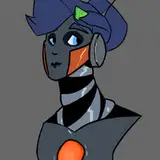
There are three differences between Kim and the other Hylarans I’ve seen so far. The first is that her tunic isn’t a silvery, slightly iridescent cloth, but stark white with a bright green belt. The second is that she’s wearing a computer on her head, a real actual modern computer, not the clunky ancient tech of the Courageous, with the visor pulled up to watch me. And the third, is that she seems to have a penchant for tattoos. Images of vibrant leaves and flowers cover her entire left arm and hand, outlines of her own bones cover her right. Some sort of swirling abstract pattern surrounds her right eye and traces over her ear. I don’t get much time to inspect them, though; I’m barely in the tent when she speaks, her voice coming through speakers mounted high up on the wall between us.
“You’re Aspen Greaves of the Courageous,” she says, her tone making it a statement and not a question. She indicates a curtained-off area on my side of the wall. “If you clean up and undress, I can take a look at you. I have your medical files from the ship, so this should be quick.”
I do as I’m told. The area contains a shower, and I’m happy to finally get out of the space suit and get clean again. I took the gold gather-ring down in my breast pocket; I make sure its not damaged before setting it carefully with my space suit underclothes.I move quickly, fully aware that the rest of my crew are waiting their turns, dry off, and walk back out.
Dr Kim has her visor down, probably reviewing my files or something, but flips it up when I come back and looks me up and down with a look so penetrating that I actually wish I had one of those hospital gowns they give you in hospital on Luna. For the first time in my life, I feel awkward about being naked. (Is this how Texans feel all the time?)
“Your medical records from the ship are pretty thorough, so today I just want to run a quick general scan to confirm good general health and run a full blood and breath pathology suite to see if you’re carrying anything that can harm the colony,” the doctor says. “Nobody here has run most of these tests before, but they’re fairly simple and the machine does most of the work so there shouldn’t be any problems. But before that, I understand you need an eye replaced?”
“Uh, yeah.”
“Then if you don’t mind, I’d like to run a nerve scan and see what condition the severed optic nerve is in. If it’s intact enough to attach to the donor eye, we can arrange to get that done. If not, we can discuss other options.”
“… other options?”
“No need to worry about that if the nerve’s repairable. Can you stick your head in the scanner? It’s over there.”
I look at the big chunky box with a head-sized hole in it that she’s indicating. “Don’t I need to take a tracer or – ?”
“This isn’t the stone age. The machine can scan just fine.”
Alright then. I bend down a bit (I’m taller than the average Hylaran) and stick my head in the hole. Instantly, padded supports shoot out from all angles, grabbing my face and holding me immobile before I can pull back. No matter how I pull, I can’t move my skull an inch. I can’t even open my jaw.
“This scan will take approximately two minutes,” Dr Kim tells me. “Please try to relax.”
Unmoving, I stare into the darkness while strange screeching sounds emanate from near my head at seemingly random locations and intervals. After what must surely be at least twenty minutes, the machine finally, mercifully, releases me. I stand up straight and stretch the ache out of my back.
“I’ll need some time to analyse this,” Dr Kim tells me, “but at first glance, I have to say, it doesn’t look promising. The doctors who did the extraction aren’t surgeons, are they?”
“You can’t replace the eye?”
“Probably not. Normally, with nerve destruction like this, I’d simply use a synthetic nerve, but synthetic nerves only really interface well with biological ones one-way. If this were a hand or a foot, that’s no problem; I could put the end of the nerves in the muscles themselves. But eyes are tricky. A lot of visual processing happens in the brain tissue in the back of the eye, and you don’t have that tissue. Replacing the eyeball won’t help, with this kind of nerve damage. My suggestion, if you don’t want to just live with the damage, would be bionics.”
“An artificial eye?”
“Yes. Can program visual processing into the eye and connect it with synnerves, I need to look into it, but it should be fairly simple, medically. Are you interested?”
“Um. Yeah. Honestly, any vision would be great. I don’t mind if the eye’s artificial.”
“Excellent. Let’s run the other tests, and I’ll look into the eye issue and get back to you. Blow in that tube over there, please.”
I blow in said tube until it beeps and swab my throat and sinuses under the doctor’s direction. She nods. “Now walk through that scanner, please.”
The scanner is a machine I’m familiar with. You just stand still in it and it makes a density map of all the tissues in your body. The Courageous has one. The device that Dr Kim directs me to after the scan is another one I’m familiar with, although the Courageous doesn’t have one – the AutoDoc blood kit.
The AutoDoc blood kit is usually only seen in large hospitals. Technically, it saves medical staff a lot of time on routine tasks, but the maintenance and repair it needs usually outweighs the benefits for anything smaller than a major population centre. I haven’t used one since Luna, but I remember how.
The device just looks like a flat display panel with two holes in it. I stick my arms in the holes, palm down, and feel around for the horizontal grip bars inside. Once I’m holding the grip bars, supports move into place to hold my arms immobile, and I’m careful to keep my forearms as relaxed as possible as scanners I can’t see detect my blood vessels and a stinging pressure in each arm indicates where the needles are being inserted.
“We’re just doing a blood draw for the pathology tests today,” Dr Kim reminds me. “There’s no need to worry. This model’s a lot more advanced than what you’re probably used to; there’s no way for you to hurt yourself. Even if you struggle against the restraints, they’ll hold you perfectly still; you can’t break the needles.”
She says this like it’s supposed to be reassuring. Me, I’m running calculations. An AutoDoc for a population of three hundred and ninety two people with three doctors. Doesn’t make sense, under normal circumstances, not with the maintenance involved. It does make sense if all those residents require a high level of medical care – maybe the colony gets sick a lot? Possibly, given that they’re using the planet’s air and water, which they probably started doing when their dome canvas integrity dropped and they ran out of replacement canvas, making keeping an isolated environment untenable. High cancer rate, or other health difficulties related to the planet’s chemistry? Possibly.
Alternately, they may lack good enough training for their doctors. It’s much easier to train somebody to maintain and repair machinery, that has a specific number of things that can go wrong and specific methods for fixing it, than to train doctors in everything that machinery can do. Training doctors well requires a critical mass of good doctors to train them, and plenty of patients to practice on. A completely isolated colony of less than four hundred people would be relying mostly on texts and training modules they brought from Earth; the machine might simply be more convenient and reliable than training the people. Dr Kim seems to know a lot about nerves, which might mean she’s highly trained all round, or might mean that they rely on things like the AutoDoc for routine medicine and the doctors spend their attention on advanced things that they don’t have machines to do. Of course, that does come with a cost – equipment. AutoDocs chew through disposable needles and machine parts at a far higher rate than doing medicine manually does, and have a lot of specialised parts that need regular replacement. The presence of this machine, still operating after so many decades, means that the colony has decent manufacturing. They’re probably sterilising and recycling disposable parts of the machine, melting them down and remaking them.
The third option is what Dr Kim is alluding to – this AutoDoc is a lot more advanced than what I’m used to. If the Hylarans’ ancestors left Earth significantly after we did, there might have been leaps forward in tech and engineering; maybe this device needs less maintenance and upkeep. But I think she’s probably vastly overstating the improvements, because they can’t have left too many years after we did, no matter how much faster their ship travelled. The math doesn’t work out. The difference, I decide, is probably a mix of all three –slightly better machines, higher needs for medical care, less doctors so less ability to widely train and specialise.
“You must be relieved to finally be on a planet again, huh,” Dr Kim says as the machine takes my blood.
“Pretty relieved. The ship isn’t in great condition.”
“So I heard. Engine trouble.”
“Among other things. It wasn’t designed to be in space this long.”
“I suppose there’s a rush to get all the colonists down, then?”
“I wouldn’t say a rush. There’s a certain level of urgency – sooner is better. But it has to be done right. Stable is better than fast.”
“What do you mean by ‘stable’?”
I turn my head to look at her. It’s an awkward angle, with my arms held fast by the machine. The blood draw has stopped, but the needles haven’t retracted. Dr Kim is watching me with that critical gaze she hit me with when I first stepped out of the shower. Watching carefully.
“Well, you know.” I try to move my arms but, of course, they don’t move. As Kim had assured me, the restraints on these modern machines are exceptionally good. I can’t even jolt the needles. “It’d be a bad idea to send all the colonists down without sending adequate food and medical supplies and soforth first.”
“Of course. Our colony has adequate food and medical supplies for our expected population, but you plan to drop down… I believe you expect over two thousand survivors?”
The needles still aren’t retracting. At this point I remember a fun little fact about how these AutoDocs work. The right arm is for blood draws, the left arm is for injections. I hadn’t even thought about it when Dr Kim told me to put in both arms, but… we’re only taking blood for pathology tests today, aren’t we? So why is there a needle in my left arm?
“Uh, yeah. We think so. Of course, it’s hard to predict these things; the revival estimates haven’t been all that reliable, but – ”
“And your here to see if our little colony can support them. And bring in whatever’s needed, change whatever’s needed, until we can. That’s your job, right?”
I’m getting a crick in my neck trying to look at her. I turn back to the AutoDoc. “We’re supposed to set up initial facilities for the colonists, yeah. We didn’t expect people to already be here, to be honest. The existence of your colony was a bit of a shock.”
“Hmm. Your vitamin C and B-12 are a little low.”
“Yeah, I forgot to get my vitamin implant redone before coming down.”
“Citrus shouldn’t be a problem with our food, but I’ll give you a B-12 injection right now.”
“No, it’s fine; I just need to eat – ” but she’s already activated the machine, and I hear the little pump inside inject the shot into my bloodstream.
“What are you plans for the colony?”
“Plans?”
“Economy. Governmental structure. Your captains are giving the orders, correct? Will the colonists be subsumed under this chain of command, or do you have another leadership structure in mind once everyone’s revived?”
“That’s not… we haven’t really discussed it? I wasn’t trained for this job, I’m an emergency replacement. Captain Kae Jin would know better than me.”
“Captain Kae Jin’s on the ship.”
“Yes.”
“Nobody who came down with you is on the crew manifest.”
“There were a – ”
“A lot of crew fatalities. I know. Anyway, that’s enough small talk; the machine’s done.” The needles retract, the supports release. I pull my arms our of the machine immediately and spin to face Dr Kim, who gives me a friendly smile. “Sorry that took so long, these machines can be a bit temperamental. You can go now. I’ll get back to you about the blood results and options for the artificial eye.”
I barely stop to thank her before heading for my clothes. I can’t wait to get out of there.
Comments
A Perfectly Normal welcome committee on a Perfectly Normal planet. That's on tract for the Perfectly Normal Spaceship story.
Noah
2024-01-11 11:25:04 +0000 UTCYikes to all of this, but I hope they get a chance to talk it out. Aspen didn't give the doc much reassurance. They answered the questions directly which was... Not the most helpful
A Scott
2024-01-08 20:35:26 +0000 UTC