This time I just want to let you know this comic is still in development, I just want to share with you a little the most, personal and I'd say difficult to explain process into scripting.
keep in mind, this works for me and I've developed this method over the years in which I've tried many things, or I had a process with less steps, but this is my "current process" that was born last year, specifically for LOST MEMORIES and XEN.
This step is the most crucial, the more plastic and it's PURE CHAOS.
for me making art and stories, is set order or build something out of the chaos of imagination, ideas and resources.
I basically here make notes about ideas, episodes, scenes, characters etc.
it's chaotic, messy and bottomline the only important thing is that I UNDERSTAND IT, I make these as representation of the abstract ideas in my head, it has an order, but the order can change, like writing scene 2, then 1, then jump back to 2, etc.
then I start describing how every scene in the comic should be and their progress step by step, usually looks like this:
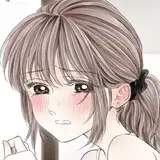
*Pixi replies to Mix, she looks shy and looks at the side. -> panel idea
"no-nothing!" -> suggested dialog
that kinda represents "a panel" in my head.
for me it's very important that this step is made by hand, in a notebook using the same style of pens. I like that my entire body connects with my creativity, it's easier for me to let go this way.
once every "episode" is written in notes. I generally check every episode again, erase stuff, change dialogs, which you could say it's a "road map" of an episode, my "outline"
in this step I try to make a proper comic script, digital this time.
I'm using a software to help me make the format quicker, I'm using a very basic software called "Trelby" which is nice for me at the time. very basic, lacks spell-checking on the downside, but generally it works for what I want, since it formats the script in a classic script form and auto-complete the name of the characters present in the script.
This step and the previous one is the most stressful for me, it's a pain, it's difficult, I hate everything I do and I doubt about what I'm writing all the time. but when it's done, it's very rewarding to feel that you fleshed out something abstract into something concrete.
an example of the previous panel in script form would be:
*Pixi replies to Mix, she looks shy and looks at the side, she's sit over Mix. (but Mix isn't shown, but it the panel allows it, try to include her face or something) -> THE ACTION description, which is the general idea for the panel I'm supposed to draw. whatever suggestion or comment I write it between ()
PIXI -> name of character speaking
no-nothing! -> dialog of the character.
This would be a panel with its dialog, this is a very regular comic format.
In this stage, I take the notes and try to write and chain the events in a coherent way, dialogs are improved, sometimes panel ideas change from the outline, in general, this is where I have to think. also decide which stuff from the outline gets into the script, which not, and also try to resume as much as possible to optimize the story.
I'll revise this 1, 2 or 3 times, change it, modify it, let it rest and revisit the episodes a few times, until I'm satisfied I'll move to...
3- Division
put marks in the scripts from which I think it would represent "a page" there's so much info and panels you can put inside a defined format.
this is estimated, since I'll not know for sure until the next step.
Some people would have a "thumbnail" stage, but I kinda skip it, because I consider my scripts enough for me to visualize the panel I want (it also helps that in panels that are critical I write longer descriptions ideas and suggestions)
THIS IS THE WIP you generally see me post here.
Sometimes I realize in order to conclude better a single "page" of the format, the page should end with a certain panel, but maybe there are several ones described... if that's happen, I need to think how to cut panels, or somehow combine panels into a single one.
I find this step very fun, and the most interesting step I desire to reach, because it's visual language and it's natural to me.
This is the second most crucial part, because the final story is what you'll read at the end.
In this stage I also put the page dialogs, which is VITAL to consider the dialog box sizes while you design every panel in the format.
when everything is done, it's time for the rendering.
Andrés Barra
2023-01-23 15:55:37 +0000 UTCTheNat'LaGuy
2023-01-21 21:09:26 +0000 UTCAndrés Barra
2023-01-21 02:40:58 +0000 UTCKit Foxboy
2023-01-21 00:52:14 +0000 UTC