Side Story 10 - A Brief Look at 10 of the Most Dominant Races of the Multiverse
Added 2021-02-07 13:21:54 +0000 UTCA Brief Look at 10 of the Most Dominant Races of the Multiverse
The purpose of this article is to serve as a brief summary of ten of the most numerous races/race archetypes of the multiverse. The article has taken certain liberties with the definition of a race, and some major race archetypes have been places under the same overarching umbrella. The reason why this is - and can be - done will be explained in each individual chapter.
Note that this is in no way a comprehensive list and only contains common knowledge and observations with a few personal conjectures of the author.
Chapter 1: Common Terms:
Before we dive into the ten races that will be explored in this article, a few common terms shall be clarified.
Chapter 1.1: Enligtened Races
The enlightened races are defined as races able to obtain classes, professions, or both. In other words, creatures not only possessing a race level. Examples of these are Humans, Elves, Risen, Lizardfolk, certain Unique Lifeforms.
For a member of the enlightened races to change their race is often challenging. They will most often remain the same race from birth all the way to S-grade (if they make it that far). Note that this is in no way negative – the enlightened races are incredibly powerful in their own right. This is primarily seen in the pure races such as humans, elves, starborne and such.
These are also often defined by their high intelligence, sapience, ability, and tendency to form structures, societies, and cultures.
Chapter 1.2: Monster
Monsters are primarily defined by only possessing a single path of leveling: their races. To try and comprehensibly explain what exactly a monster is, however, impossible. Beasts, most Unique Lifeforms, elementals, most undead, plant-like lifeforms, etc., are all monsters.
The creatures defined as monsters will also often be able to change their race far more easily. They show a tendency to remain within the same general species but can experience significant changes. While the enlightened races rarely change much physically through evolutions, monsters can undergo substantial metamorphosis.
There is no way to tell them apart by appearance either. A humanoid figure can easily be a monster such as a doppelganger, mimic, or shifter. If they are of a high grade, it could be any type of monster in existence that has simply taken human form.
Chapter 1.3: Beasts
All beasts are monsters, but not all monsters are beasts. A beast is a creature resembling animals and is a subcategory of monsters. Beasts tend to be creatures primarily moving on instinct, but some evolve into having a high level of intellect.
Chapter 1.4: Elementals
Elementals are beings of mana. Elementals are beings of mana, which is their only resource. This allows their bodies themselves to become weapons. Elementals of nearly all affinities exist as long as areas with sufficient concentration of the mana exist.
Chapter 2: Humans
Humans… what is there to say? It is impossible to meet any being of the multiverse not aware of them. Humanity is the most numerous race by far, present in all universes before their integrations and often dominant even before the system’s arrival.
When speaking of the enlightened races, humans are often the first that springs to mind. Quite naturally so, as humans do exemplify that description.
Human – as a race – is by far the most diverse of the multiverse. Their stat gains are equally spread and the race itself provides nearly no skills. Instead, humans have the inherent ability to possess both a class and a profession. One could even call this their true racial skill. While this isn’t unique in any way, it is usual for their race not to influence their path to power significantly.
Humanity has a great ability to reproduce, mainly due to the inherent limitations of their newborn. The highest grade a human can be born at and grow naturally to is D-grade, though their D-grade level varies. This limit can be somewhat circumvented by crossbreeding with more powerful races, creating hybrids, but will also result in the child not having the pure human race.
Many subraces of humans exist, often related to certain magic affinities or through certain transformations. The first will often only result in some race skills and different stat gains, while the latter can lose either class or profession, though they are often a fusion of the two.
Chapter 3: Scalekin
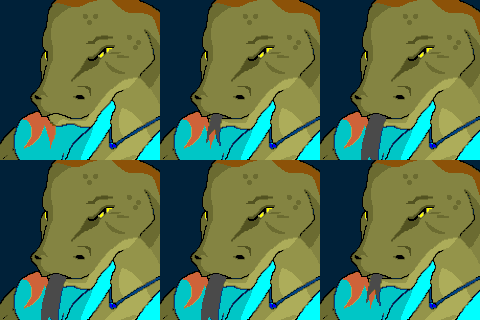
The scalekins are not a specific race, but more a collection of races. Also called reptilians – though that is often viewed as a more derogatory term used by the ignorant – the common trait of this race is the scales covering their bodies and that their eventual humanoid form always retains some of these scales.
Within this race, the most noteworthy is, without a doubt, the dragons. A powerful race with incredible magical and physical power, and often the end-goal for many scalekins’ evolutionary path. The scalekin were originally all monsters and beasts, but their descendants now hold the enlightened races' traits.
Crossbreeding with other races has resulted in humanoid scalekin that possesses many of the traits of humans. With access to both professions and classes, these new races have risen to a position of dominance.
As scalekin, stat-gains usually focus more on toughness and other physical stats than mental ones, though it does vary heavily by their specific race.
Chapter 4: The Undead
When speaking of the undead, one thing must be made clear immediately: the difference between the Risen and the original undead.
The undead were originally all monsters, with the majority not having even a shred of intelligence - specters, skeletons of fallen creatures, given new life through an abundance of death-affinity mana. Initially, they could only be found in desolate areas or on old battlegrounds, but with the rise of Blighfather Inmortau, that all changed.
The Primordial created the first Risen – himself. Intelligent races turned undead, able to retain all prior memories and personality. It was a race change, more than anything, but into an entirely different kind of lifeform.
Able to retain nearly all properties as the race they changed from, the undead have become a powerful race throughout the multiverse. The archetype Risen Human is the most numerous, mirroring the fact that humanity is the most prevalent race in the multiverse.
Due to their preference for death-affinity mana, they tend to stay in secluded parts of universes, but that does not mean the undead cannot live anywhere as they wish. It is hard to find any pinnacle factions without undead in them.
As for reproduction of the undead race… it gets a bit more complicated. Unlike other races, breeding is not the only way for the undead race to propagate. Many new Risen come from enlightened races willingly becoming undead and joining their race.
Contrary to what many may believe, the Risen still can reproduce. However, it can only be done with other undead, and it requires special items mass-produced by their race to do so, so crossbreeding with living races is impossible.
The stat gains for any Risen lean towards staying the same as their living forms, but with the new Spirit stat gained instead of vitality and endurance for the races that possessed those prior.
Chapter 5: Elves
The elves are very closely related to humans in both appearance, abilities, and traits. Yet, some major differences distinguish the two.
Firstly, the lifespan of elves tends to be longer than humans.
Secondly, their stat distributions are more skewed with less focus on strength, toughness, vitality, with more in other less physical stats. This has resulted in the elves mainly specializing in ranged combat and magic while they lack warriors. Culturally, warriors are also looked down upon, reducing their numbers even further.
However, this aspect does differ between the elven empires, especially those made up of different elven archetypes. Wood Elves prefers archery and nature magic, while the Dark Elves prefer shadow magic and stealth-focused fighting styles. But it would be wrong to merely put any race in a box and assume they will follow an absolute path.
Third, the elven race reproduces far less than humans. Given their longer lifespans coupled with the potential to have children reaching C-grade (also known as High Elves), the birthrate is far lower. This has resulted in the elves placing far more importance on quality than quantity.
Fourth, while the elvish are numerous throughout the multiverse, they tend to keep to themselves and create their own separate empires or settlements. Case in point are examples such as the Altmar Empire, a faction with many gods and a focus on elvish supermacy.
However, be aware that even if the elven empires have been shown to believe themselves superior, they do show adequate respect to other equally superior beings from other races.
Chapter 6: Starborne
The starborne are a race of mighty beings created from the stars themselves, as the name suggests. Even the weakest is at B-grade while the strongest come into existence at S-grade. These creatures possess incredible power and intellect and often do not seek to form societies but merely join whatever faction suits them.
What sets them apart from many other wondrous creatures of the multiverse is their number and ability to reproduce. Known to be able to have children with nearly every other race, they can propagate more starborne subraces: Starborne Humans, Starborne Elves, Starborne Lizardkin, and so forth.
Physically they have a tendency to resemble humans or whatever else race they choose to imitate. While it is hard to believe, not much is known of this race, as they choose to remain relatively enigmatic. Information given out is also often contradictory, perhaps purposefully spread to confuse any scholars.
Chapter 7: Beastfolk
The Beastfolk came into being much like the scalekin but has nevertheless been categorized in their own way. However, it must be mentioned that most scalekin with a humanoid form as their base can be defined as beastfolk, though they prefer scalekin.
Beastfolk are also classified into two distinct groups. Those focused on their more animalistic properties are called the Bestial, while the ones focusing more on the ‘folk’ part of their name are known as the Adapted. The Bestial tend towards more tribalistic societies. They shun technology and most forms of magic in order to pursue a more primal, purer path.
On the other hand, the Adapted mimic the human and elven cultures closely and are often found living among both races. Their societies tend to be very diverse and welcoming to all enlightened races, resulting in cities where you can find everything from dwarves to titans.
This openness likely stems from how diverse beastfolk are, to begin with. There exist nearly as many types of beastfolk as there exist beasts. This also means that the reproductive abilities, breeding process, and culture can vary heavily between different beastfolk archetypes.
The access to classes and professions also varies widely between beastfolk and the pure races. Some beastfolk receive far more race skills and stat points from their race, resulting in only having access to either a class or a profession.
Chapter 8: Ectognamorphs
Ectognamorphs, also called insectoids, ectomorphs, or in more common speech: ectognas.
Yet another race often confused with the beastfolk, but they are most certainly not. Ectognas are monsters, but monsters with a lot of things that set them apart.
One thing that sets ectognas and nearly all other races apart are their societal structures. Often, these consist of clear distinctions of higher and lower castes, not just defined by ability or culture, but by race potential and purpose of existence.
While the title of King or Queen for most enlightened species are just professions and titles, it’s a race for the ectognas. Those of the lesser caste often never develop their own intelligence even as they advance and are tethered to a higher-ranked member of their race. Individuality and ego are often not a subject of existence for these creatures.
Breeding-wise, this race also sets itself apart. Having up to a dozen offspring for nearly any other race in a single act of copulation would be a lot, and this inevitably results in a lower grade of each offspring produces.
For the ectognas, creating millions or even billions of eggs are not out of the question - S-grades creating endless armies of weaker being all the way down to the lowest of F-grades.
However, some ectognas evolve to become individualistic creatures, not much different from the enlightened races. However, one thing must be made clear no matter how closely an ectogna resembles a human; they will forever remain a monster.
Ectognas can be found in many factions of the multiverse. However, they are often discriminated against as their race has many negative stereotypes associated with it – most for a good reason. For a single queen to nurture her personal army, entire galaxies may be consumed.
This race has in some cases been known to breed with enlightened races. However, it can only be done when they reach a high enough grade, and it has only ever been observed happening between the higher caste and enlightened. The children of this will nearly always result in a child of the ectomorph race, and it will be of the higher caste every time, with a high chance of a variant race. It has been theorized this is the reason why many queens choose to entice and breed with outstanding beings of the enlightened races.
Chapter 9: Automata
The automata is the only race created entirely through artificial means that has risen to such a state of prominence in the multiverse. The first members of this race were created by a forgotten race of the 1st era, with the automatons serving as soldiers as far as historians theorize.
Yet, their creators failed to push through the final step and create an automaton of the highest grade. As gods began to emerge in the far corners of the multiverse, they began to fear for their existence and sought to create a god of their own.
But they failed. Their creation only a demigod, even if it stood at the pinnacle of power among mortals.
Yet that automata understood its path to godhood. It purged the entire race that had recreated it and posthumously named them the Maker’s while itself taking up the title of Rigoria the Maker – one of the twelve Primordials.
Rigoria began creating more automatons and allowed those that had already been created to join it. The race eventually became its own thing, splitting away from the primordial and established their own cultures and individualistic goals. Most still pay homage to the Maker through religious practice, though.
The automata race is in many ways unique. As they cannot reproduce in any way, they instead have to create new members of their race. This also means that automata can be created at nearly any grade, with there even being rumors of Rigoria being able to make god-grade automata.
Automatons do not have vitality or stamina as biological creatures but run on pure mana. In many ways, the automata can most easily be compared to elementals in this vein.
Appearance-wise, an automaton is often indistinguishable from humans, but it varies heavily. Some automata instead assume a shape far more machine-like.
Chapter 10: Demonkin
The Demons are another relatively normal race of the multiverse, often compared to the more human-looking beasts despite the vast difference in physical appearance this race can display. From hulking behemoths to small, lithe creatures, demons are more a classification of races than a race in itself - a suffix to a more extensive collection of races.
Demons tend to place heavy emphasis on cultural class and hierarchies, and it has been theorized they possess an inherent need to fit into larger societal structures. The reason why the demons are even viewed as their own race and not many different races is due to how they often pair up with each other.
The society created by demons is structurally sound, with each member given a role. Some demons can obtain professions, classes, or both, while other demons are monsters, but all possess inherent abilities relative to their specific subspecies of demonkind.
As an example, Imps are monsters with extraordinary ability in magic but weak physiques. An Observer possesses unparalleled perception and powerful defensive and healing magic but is even weaker than an imp in a physical confrontation. In contrast, a Demon Behemoth – or any of their variants – possesses mighty bodies and defenses with little to no talent with magic.
Couple these together, and you have a powerful team.
Even in the social area, they are split. Some subspecies of demons possess incredible abilities to craft equipment, while others have inherently powerful social skills. Succubuses and incubuses are often sent as political envoys to other factions, which has helped the demonic empires to entice many powerful aspects over the years.
Demons are – contrary to what many believe - a very welcoming race to powerful experts or promising talent of other factions, and it is hard to find factions in the multiverse without demons in them. However, be aware that demons tend to be extraordinarily loyal to their hierarchy - therefore, ensure that your organization is where that loyalty lies.
On a final note: Demons who ascended to godhood will often call themselves devils; however, there is no difference between a god or a devil. It is merely a name they have adopted for themselves and separate demons who have attained godhood from other types of gods within their own social circles.
Chapter 11: Unique Lifeforms
Finally, we come to a race that is not a race at all. This is the only one that can only ever be called a categorization as Unique Lifeforms are by definition unique. No two Unique Lifeforms ever have any connections besides their relative origin.
These entities are created from the multiverse itself, without any seeming rhyme or reason behind it. They are not like the usual mindless monsters spawned by the system throughout the multiverse, but each holds an absolutely unique race.
If this was all they were… Unique Lifeforms would not require their own classifications, as they would just be common monsters. But these creatures are so much more.
They do not have any specific grade at which they were born, but very few have been observed that come into being below D-grade. Their level and grade appearing truly random but usually fitting the general environment in which they are born; trying to predict anything about these creatures is impossible. Not even the greatest oracles can divine the birth of a Unique Lifeform, and to make it even worse, many tend to have an inherent resistance to divination.
Another thing they all have in common is that they are apex creatures.
The disparity in strength between entities of the same level can vary widely. For monsters, it comes from stronger variants and their species, while for the enlightened races, it depends primarily on their class, profession, or both.
Due to how much harder it is for the enlightened races to grow in power and their relatively higher intellect, it is common knowledge that they are often vastly superior to beasts and most monsters. For a human or elf to kill beasts and monsters at least a few levels above their own is only to be expected. Geniuses were often able to slay beasts dozens of levels above their own – the most supreme of geniuses even able to face a being of a higher grade.
Yet even a supreme genius will find themselves struggling – likely losing - before a Unique Lifeform of equal level.
Unique Lifeforms are highly sought after by nearly all factions of the multiverse as they are supreme geniuses by default. If they survive, most Unique Lifeforms reach S-grade if not godhood, making them extremely valuable members.
No Unique Lifeform has ever been observed as able to reproduce.
Unique Lifeforms will not change race upon evolution, simply have their grade upgraded. They are born at the crevice of perfection.
While it may seem like there is a lot of knowledge about Unique Lifeforms, it is quite the opposite. But one thing is clear. However, the Records that make up their existence are often among the most tremendous for their rank in the multiverse and often makes them a target worth slaying for any with the ability to do so.
Conclusion
While races are an essential aspect of the multiverse, they tend to have less impact on society than many assume. Factions consisting of a limited number of races are few and far between. Even the most isolated ones, such as certain elven or ectognamorph factions, still openly welcome outstanding individuals of other races into their fold.
The race is instead the source of stat gains and the path of many living beings. It matters far more for monsters, being their sole path of growth, while for the enlightened races, profession, class, or both, will be their primary path of development.
As a final note, it must once more be reiterated this small article is in no way a comprehensive look into the many multiverse races - some due to their limited number and others. There is simply not enough available knowledge about them.
Just be aware that the total number of races is almost endless, with new ones appearing every moment. Some powerful and some weak, while some occur in places only the gods can explore.
Many will also likely question the lack of mention of beings that dwell within the Void. These creatures – unimaginable entities born with the power of even some of the most powerful gods – are simply too powerful for this common text to even dare approach. To deal with those is in the domain of the gods.
Comments
I imagine these indispensable beings in the automata are producers that create other automata, ones that are better at creating than others, save for rigoria
HentaiAddict
2025-04-23 19:29:37 +0000 UTCI’m really dying to know more about the Automata. It was mentioned before that they have certain individuals in their empire they can’t loose no matter what just like the Endless Empire. But while I understand the Ectonas because loosing a true Royal would mean potentially loosing control of huge portions of their armies, what makes those gods from the Automata legion so special and indispensable
Phil Ritter
2025-03-01 12:24:00 +0000 UTCWhat about dwarves? Vampires? I'm assuming this means in terms of populations they are not as prominent
Miles Mouton
2024-11-16 21:18:25 +0000 UTCI really liked this one, I would love to see more lore texts in the future
Linbi
2022-02-17 23:36:45 +0000 UTCIs the king in the tutorial a unique lifeform?
Sterban Friz
2021-09-04 20:30:48 +0000 UTCFixed
Zogarth
2021-04-08 11:26:44 +0000 UTCI love this and I hope there are more tome/texts to come!
Duder
2021-04-07 22:58:16 +0000 UTCThe latter will often only result in some race skills and different stat gains, while the latter can lose either class or profession, though they often a fusion of the two. >> though they are often a fusion A powerful race with incredibly magical and physical power >> A powerful race with incredible magical ...
Duder
2021-04-07 22:57:55 +0000 UTCFixed stuff, thanks. I knew this one was quite rough.
Zogarth
2021-03-31 18:14:27 +0000 UTC"For a member, the enlightened races to change their race is often challenging." --> "For a member of the enlightened races, changing their race is often challenging." "Elementals are beings of mana. They only have a single resource in their mana, and their bodies are weapons in themselves" the wording here is a bit rough IMO, maybe "Elementals are beings of mana, which is their only resource. This allows their bodies themselves to become weapons." or something. " Their stat gains equally spread and the race itself providing nearly no skills." This isn't a complete sentence, it needs a verb. Try, " Their stat gains are equally spread and the race itself provides nearly no skills." "Within this race, the most noteworthy Is," Is--->is. "the undead has become a powerful race " wrong tense. has--->have "Many new Risen comes from enlightened races willingly becoming undead and joining their race." comes -->come
Johnny Smithers
2021-03-31 17:44:40 +0000 UTCFixed, and thanks!
Zogarth
2021-03-13 18:57:14 +0000 UTCit most once more reiterated certain elven er ectognamorph starborne subraces -(:) Starborne Humans, ... It merely a name The articles has taken certain liberties
2021-03-13 18:50:31 +0000 UTCFixed. I know there are quite a few things in this chapter overall...
Zogarth
2021-02-08 18:17:39 +0000 UTCYet that automata knew understood --> yet that autmata understood Rigoria kept began creating more --> Rigoria began creating more
Vaccus
2021-02-08 18:10:04 +0000 UTCFixed.
Zogarth
2021-02-07 18:49:31 +0000 UTCare viewed even viewed as -> are even viewed as
Silvertooth09
2021-02-07 18:47:16 +0000 UTCokay got it! "*beat a being from the void when jake reach godhood"
happy cuddled senko pillow
2021-02-07 15:03:33 +0000 UTCFixed.
Zogarth
2021-02-07 13:52:02 +0000 UTCObtain races, professions or both -> classes, professions or both?
Nim
2021-02-07 13:49:59 +0000 UTCFixed.
Zogarth
2021-02-07 13:44:20 +0000 UTCThere is simply not being enough
Littleme02
2021-02-07 13:39:27 +0000 UTC