This Devlog is one that I originally didn't want to do, as it doesn't directly involve Mist, but is more offtopic. It is about me learning new skills and trying out new workflows to someday implement into my games. Something I don't always want to show, as it is just work in progress and often never even get's used. But this time it became a little more than just trying out someting new. I want to tell you about how I struggled and failed and ultimately succeeded in learning a new method for creating 3D Hair.
Part 1: The post that started it all.
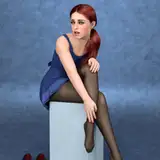
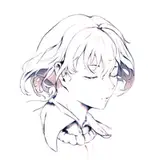
There is an artist called Nazar Noschenko, who does beautiful hair in blender (the software I use for my modelling). In 2020 he posted his version of Sophie, from the ghibli movie: "Howls moving castle".

From the textures, to the model, to the pose and lighting everything is so incredibly clean and well made. Really something to strive for, even though I know that it will take many, many more years until I can even think of reaching such a level. What caught my eye the most, was the hair. A perfect blend between realistic and stylized, flawlessly executed. I wanted to see if I could learn his techniques too. That is what started my journey into the world of 3D hair creation.
Part 2: A different type of hair.
Up until now, all my characters have something that is often called polyhair. It is made up of big chunks of Geometry and not individual strands or. It gives a very stylized look.

That is what I am most used to. Something I originally picked up because it is easy to control and renders quickly. What Nazar Noschenko uses is different. He uses particle hair. So every single strand of hair you can see is actually an individual object. This is what Pixar uses in their films. it produces good looking results, but is heavy on the hardware and can't be used in realtime games because of it. It also works very differently from Polyhair. So I decided to try it out following a tutorial by the aforementioned Nazar Noschenko. This was the result of my first and only try of doing particle hair.

It's not bad... Not very good either, but for a first try I was honestly surprised how good it looked. A few months of training and it might look great! ... There was a problem though. As I already said, it doesn't really work in realtime. In actual games. And while right now I am working with Ren'Py and not a fullfledged engine like Unity or Unreal, I already know that someday I want to make the switch to those. So how much time do I want to spend on a skill I eventually won't be able to use? I scrapped the idea and knew that there was only one option left.
Part 3: Trying Haircards.
Haircards are used in pretty much every game with somewhat realistic hair. They are flat 2D strips of hair that get layered on top of each other to look like real hair. They look realistic and are easily handled by gameengines.

I might be wrong on this one, but from what it looks like this is also what DAZ models use. It is basically the standard. A standard that I avoided for a long time and I quickly learned why. Day 1 of learning haircards I had to realize something. I am really, really bad at it. After watching several tutorials, studying some works on Artstation and looking at different artists workflows, I felt ready to try it out. This picture is probably the most embarrassing and funny picture I've posted on here. It shows a horrible try that I quickly had to stop doing because it was just too bad. Feel free to laugh.

And as if that wasn't bad enough. It wasn't even my first try. Several times things came out looking like this. I was clearly doing it very, very, very wrong. So I slept over it and came back the next day. What was going wrong? The workflow itself wasn't bad. My main source of information was this video, by John Lithvall who was involved in making the hair for Horizon: Zero Dawn. He clearly knows what he is talking about. Yet when I tried to follow his techniques it looked like garbage. I thought about it and realized the biggest problem. I was very bad at manipulating the shape of the haircards. Up until now I had made my hair by using Beziercurves. They are easy to place and manipulate and make it easy to get a nice flow and pretty shapes. When I directly manipulated the Haircards they quickly lost shape and became really flat. I had to learn from the ground up how to do it. Or... Or I could just go back to my old workflow.
Part 4: Haircards with Curves.
I was already used to making hair with curves and I knew the proper workflow to get good looking Haircards. I just had to combine the two. Some fiddling around and trying different methods led me to a very simple solution. I made clumps of haircards that were similar to Polyhair and then combined them with the curves so they would follow it's shape.

I now had the best of both worlds. Haircards+Curves. And that is where things started to fall into place. I set down and started modeling my first full head of haircard-hair, following John Lithvall's principles. The result left me very satisfied.

It finally looked good! Better than I'd imagined even. My trick worked out and I was now able to make some decent looking hair. Another try quickly followed andI now knew that it wasn't just a fluke.

I am really able to do it and best of all, I am still at the very beginning. From the quality of the haircards themselves to my speed at placing them to understanding hairflow and shapes there is still a lot of room for imprvements. Which will happen, slowly over time. I can do haircards if I want to and I have a new tool in my belt. This still leaves me very far from Nazar Noschenkos version of Sophie, but it still feels like a win.
I hope you could enjoy that little glimpse into my learning process. You'll hear from me again next monday. Until then, stay safe!
Theo
2021-08-10 09:01:52 +0000 UTCDavid Ryan
2021-08-09 19:59:42 +0000 UTCTheo
2021-06-21 07:17:05 +0000 UTCOsama Habib
2021-06-21 07:11:03 +0000 UTC