HQ 3k full artwork: https://www.patreon.com/posts/84918276
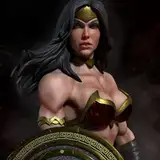
My idealized Basil.
Some of my favorite old artwork with Basil: https://www.patreon.com/posts/basil-scythian-29887878
***
Basil Lekapenos was a powerful eunuch and ruler of Byzantine empire. He was an illegitimate son of the Byzantine emperor Romanos I Lekapenos who served as the parakoimomenos and chief minister of the Byzantine Empire for most of the period 947–985, under emperors Constantine VII, Nikephoros II Phokas, John I Tzimiskes, and Basil II. His mother was a slave woman of "Scythian" (possibly implying Bulgarian) origin. And his father Romanos was of Armenian-Macedonian origin.
***
The history of Byzantium is dotted with examples of what some historians condemn as over-powerful eunuch courtiers, who attempted to dominate their rulers. From Chrysaphios in the fifth century, Euphratas under Justinian and Theodora, to Staurakios and Aetios, rivals for Empress Irene’s affections, Samonas in the ninth, Basil Lekapenos in the tenth, and John the orphanotrophos (in charge of the large Imperial Orphanage in Constantinople) in the eleventh, the list is extensive. Basil Lekapenos, an illegitimate son of Romanos I, known as ‘Nothos’ (‘the Bastard’), made a particularly successful career. After being castrated as a child to destroy any imperial ambitions he might have developed, he was appointed parakoimomenos by Constantine VII. He held on to great power through the rule of Nikephoros II and John I, and practically governed the empire during the first decade of Basil II’s reign (976–85). With his great wealth, he commissioned magnificent art objects such as the Limburg reliquary. He also wrote a treatise on naval battles and had it copied in a splendid manuscript of military Taktika.
In this respect, Basil Lekapenos was typical of several high-ranking eunuchs who became art patrons, diplomats, generals, administrators, teachers, writers, theologians and churchmen (plate 10). In many cases these officials were detached from their court duties to undertake particular missions, diplomatic or military, such as Andreas, who negotiated with the Arabs in the seventh century, or Theoktistos, who commanded the navy in the ninth century. In Byzantium, as in the caliphate, eunuchs regularly found employment as military generals and diplomats. Their high status is confirmed in the Book on the Interpretation of Dreams, written by a Christian Greek author, Achmet, who drew on Byzantine and Arabic sources as well as on his own dreams. In common with many authors, he equates beautiful eunuchs with angels. Both of course were considered sexless beings, since angels have no sex and eunuchs were supposed to have lost theirs.
As well as these high-ranking eunuch officials, others made careers far away from the Great Palace and imperial patronage. They appear incidentally in hagiographical sources, and sometimes feature on a list of wedding gifts, as in the story of Digenes Akrites, the frontier hero. When Digenes Akrites finally married the girl (she is never named), her eldest uncle presented them with ten boys:
Sexless and handsome with lovely long hair,
Clothed in a Persian dress of silken cloth
With fine and golden sleeves about their necks.
— Byzantium: The Surprising Life of a Medieval Empire by Judith Herrin.