The 2022 draft began Sunday night and the Yankees selected Vanderbilt slugger Spencer Jones with their first round pick. Here’s my pre-draft profile. Last week I mentioned the Yankees really like Jones (I’m not sure another team would have taken him in the first round) and he’s very Yankees-like. Big kid, huge power, great athlete. I’ll have more on the Yankees’ entire draft haul later this week. My quick take on Jones: I dig it and am pleasantly surprised the Yankees took a big swing on a player with significant ceiling. They’ve been conservative with their last few first rounders. Jones has a chance to be a star, albeit with a lot of development ahead of him. The rest of the draft class looks like a typical Yankees class so far, meaning a bunch of pitchers who we’ll hear are throwing harder than ever next spring. Here are their picks and here is today’s post.
1. Midseason review. The All-Star break and the traditional midpoint of the season have arrived even though the Yankees have already played 92 games, or 57% of their schedule. They have baseball’s best record (64-28) and best run differential (+199), and James Smyth says that is the second best first half run differential ever. Ever? Ever. Only the 1939 Yankees were better (+217)*.
“It’s pretty big. It’s pretty cool,” Gerrit Cole told Bryan Hoch about the team’s season to date after Sunday’s blowout win. “But we have bigger goals. We have a lot more baseball to play, so we’re trying to keep it in perspective, in that regard.”
* The All-Star break was unusually late this year. On a rate basis, the 2022 Yankees have the fourth best first half run differential in history (+2.16 per game), which is still amazing.
The Yankees hit a bit of a lull in July that saw them go 6-7 with several annoying losses in their final 13 games before the break. They were unlikely to play at a 116-win clip all year (because almost no team does that) and I think this is a really good 105-ish win team more than an all-time great 110-plus-win team. And that’s amazing! That’s like 10-12 wins better than I expected.
A postseason berth is in the bag and the Yankees are sitting pretty with a 13-game lead in the AL East. The most important race moving forward is the race for baseball’s best record and thus home field advantage throughout the postseason. Here is the top of the MLB standings:
The Dodgers are 20-5 in their last 25 games and charging hard. If they zoom past the Yankees, what can you do? Even with two teams this good, the odds the Yankees and Dodgers meet in the World Series and home field advantage actually matters are small. It’s more important the Yankees finish ahead of the Astros. They seem destined for another October showdown.
I’m not a fan of the “grades” format and if you’re reading this, you know who deserves an A and who deserves an F. Instead, I’m going to highlight the important storylines from the first half for my midseason review. Let’s get to it.
It can be easy to forget now, but the vibes were not good coming into the season. The Yankees had a frustrating season a year ago and were sent home in the AL Wild Card Game, then had an underwhelming offseason. Then the Yankees failed to reach a long-term extension with Aaron Judge, and even announced the terms of the offer (seven years at $30.5M annually, starting in 2023), which is basically unheard of.
"I don't like talking numbers. I like to keep that private,” Judge said on Opening Day. "... Very few people get this opportunity to talk about an extension. Me getting this opportunity is something special and I appreciate the Yankees wanting to do that. But I don't mind going into free agency. At the end of this year, I'll talk to 30 teams. The Yankees will be one of those teams."
Since turning down that extension Judge has done what once seemed impossible: he’s made himself more money. Judge leads baseball with 33 home runs, four more than any other player and tied with 1961 Roger Maris for the most in a first half in franchise history, and he’s hitting .284/.364/.618 (172 wRC+) through 92 team games. It’s his best season since his historic rookie season in 2017. He leads all position players with +4.7 fWAR and is fourth with +4.4 bWAR.
For Judge, the biggest developments this year (and really dating back to last year) are health and an increase in contact. He played only 242 of 384 possible games from 2018-20, or 63%. It’s 89 of 92 (97%) this year and 237 of 254 (93%) since last year. He spent 10 days on the COVID list last July and had some calf tightness earlier this month, and that’s it. Judge has been healthy otherwise.
Truth be told, the Yankees are much improved at preventing injuries. They have lost the seventh fewest man-games and fifth fewest WAR to injury this season. After the injury disaster that was 2019, the Yankees overhauled their health and training department, and the results are showing now. Judge is the primary beneficiary. He stays on the field and that equals MVP production.
As for making more contact, Judge has cut his strikeout rate down to 25.7% this year, well south of the 30% strikeout rates he ran from 2017-20. His 11.2% swinging strike rate is almost exactly league average. This giant hitter with long arms and a ton of strike zone to cover is swinging and missing at a league average rate. That seemed impossible a few years ago, but it’s reality now.

Judge’s ability to hit the ball hard is almost unmatched. His 24.6% barrel rate leads qualified hitters by 2.9 percentage points and his average exit velocity (95.4 mph) and hard-hit rate (60.2%) are second only to Yordan Alvarez (96.0 mph and 61.0%). Combine that hard-hit ability with league average contact and you get MVP production, and a whole lotta contract leverage.
If the season ended today, I’m pretty sure Judge would be named AL MVP, but it doesn’t. Shohei Ohtani has been out of his mind the last two months and others like Alvarez, Rafael Devers, and Jose Ramirez are putting up numbers similar to Judge. Also, MVP is a narrative award, and the Yankees being so good could work against Judge (they’d win the division without him, etc.). It’s dumb, but you know it happens.
This is the best ever version of Judge. He makes way more contact than he did as a rookie without sacrificing power, and he’s staying on the field. He’s also sixth among hitters in win probability added and third in championship probability added. Judge is very productive and clutch. I’m not sure what more he can do for the Yankees. He is their everything.
“I don’t know that we needed any more proof of how important Aaron Judge is to this team,” Aaron Boone told Dan Martin over the weekend. “He’s been the straw in the middle of a strong start to the season.”
The lower key approach to the offseason meant the Yankees would need a few players to have bounce back seasons this year, and in some cases we’re talking about players who were several years removed from their last above-average season. Chief among them: DJ LeMahieu, Gleyber Torres, and Luis Severino. It was a risky strategy. No doubt.
The risk has been worth the reward. All three have bounced back about as well as we could’ve hoped. LeMahieu is not quite 2019-20 LeMahieu but he’s hitting .279/.383/.403 (132 wRC+) with more walks (13.4%) than strikeouts (12.6%). The power is not quite there but the defense is. LeMahieu has been great in the field, particularly at third base, after hernia surgery.
In the grand scheme of things, Gleyber’s rebound is most important because he is the Yankees’ youngest regular, and the gap between what he was the last two years (barely league average) and what he can be (All-Star caliber) is significant. The rocket ball is gone and expecting 38 homers again wasn’t realistic. But 12 homers from 2020-21? I mean come on.
Torres has resurrected his career this year and he’s a new hitter. Even while disappointing everyone the last two years, Gleyber had good at-bats, and that’s what was so frustrating. He worked the count, swung at the right pitches, had better than average swing-and-miss and strikeout rates. It was just that when he hit the ball, nothing happened. He had no pop.
This year Torres is running the best contact quality numbers of his career. Career best average exit velocity (91.0 mph), career best hard-hit rate (45.2%), career best barrel rate (9.6%). This is almost two completely different hitters (full-size image):

With all due respect to LeMahieu and Anthony Rizzo and everyone else, I think Torres has been the Yankees’ second best player this year. He’s hitting .268/.325/.484 (career best 129 wRC+) with 14 home runs, two more than he hit the last two years combined, with a 19.0% strikeout rate. Gleyber is also much better defensively at second than at short.
I soured on Torres last season, so much so that I traded him as part of my Offseason Plan, and I’m thrilled to be wrong. The power has returned without sacrificing contact. New hitting coach Dillon Lawson recently explained the return of Good Gleyber stems from using one swing and staying consistent. From Kristie Ackert:
“There were really slow changes (to his swing) from 2018. It goes with him trying to be a complete hitter, which these guys want to do. They want to be able to hit for average and for power,” Lawson said. “In 2018 he definitely was doing that and used it for power and power in 2019, but he was trying to get back to average and then basically kind of got himself out of sorts, out of good habits while trying to get into some other good things.”
…
“So he didn’t have to try and force it to the opposite field for batting average, and then cheat to try to pull it. In that case, he’s basically been trying to use two different swings,” Lawson said. “Now, he’s using one. In 2018 he used one. Now he uses one and it’s just able to cover batting average and it’s able to cover power and it’s in fastballs and changeups and sliders and curveballs and righties and lefties. It’s just that one swing that he’s really honed in.”
If Gleyber’s bounceback is most important, Severino’s is most satisfying. Injuries limited the erstwhile ace to 39.1 innings from 2019-21, postseason and minor league rehab included, and he was an unknown coming into the season. He hadn’t been part of a rotation in four years. How would he hold up? How would he perform? Is the old Severino still in there?
It turns out this is a new version of Severino. The old Severino was a fastball/slider dominator. This Severino is a four-pitch guy with confidence in his changeup and a willingness to stand lefty hitters up with cutters inside. He is a much more complete and refined pitcher, someone capable of outsmarting hitters in addition to blowing them away.

Going into his last start Severino owned a 3.11 ERA (3.54 FIP) with strong strikeout (27.6%) and walk (6.8%) rates in 84 innings. Considering the guy missed close to three years, I’m not sure what more anyone could have wanted. Alas, Severino’s last start was ugly (four runs and three homers in two innings), and he’s now on the injured list with a “low grade” lat strain.
Boone said Severino will “probably” be shut down two weeks, and a two-week shutdown period means a few bullpen sessions and a minor league rehab start to ramp up, so we’re looking at what, a 3-4 week absence? The Yankees have a big enough lead that losing Severino for a month isn’t a major concern, but it is another arm injury, and that’s never good.
Coming into the season the two questions with Severino were could he be effective again, and could he stay healthy? It seems like he’s answered the first question with a resounding yes. Severino was very good the first three months. The second question? Eh, I dunno, and at this point I dunno probably just means no. Fingers crossed this lat injury is truly nothing major.
The larger point is the Yankees came into the season needing more from LeMahieu, Severino, and Torres than they got last year and they’re getting it. Last year those three combined for +2.6 WAR. This year they’re already at +7.6 WAR: LeMahieu at +3.5 WAR, Torres at +3.0 WAR, and Severino at +1.1 WAR. That’s an enormous swing in production.
Banking on so many players to have bounce back seasons was a risky strategy, especially for a team that fancies itself a World Series contender. It has worked wonderfully though. LeMahieu is healthy post-hernia surgery, Torres has rediscovered his power stroke, and Severino was very good before this lat injury. The gamble on these three paid off big time in the first half.
The Yankees badly needed to improve their defense over the winter, particularly on the infield. Bad defense hurts in so many ways. It gives the other team more baserunners and more runs, it forces your pitchers to throw more pitches, and more pitches means more relievers have to be used to cover the same number of innings. The negative impact just keeps compounding.
So, the Yankees reshaped their infield by bringing in Josh Donaldson to play third base (most of the time) and Isiah Kiner-Falefa to play short. They also shifted Torres to second and brought back Rizzo, an error-saving machine at first. LeMahieu is moving so much better now that he’s no longer playing through a hernia too. The Yankees also swapped out Gary Sanchez for Jose Trevino, who wrestled the starting catching job away from Kyle Higashioka.
Donaldson’s bat has slowed and I think the Yankees expected more from Kiner-Falefa on both sides of the ball, but even then the defense has improved. Rizzo’s been Rizzo and Trevino has been a revelation at catcher, even if he wasn’t going to keep up a 130 wRC+ all season. As a result, the Yankees went from having one of the worst defenses last year to one of the best this year.

Defensive stats have large error bars and are best used directionally. They’re not precise enough to definitively say a +10 defender is better than a +8 defender, but they can point you in the right direction. Are the Yankees truly the best defensive team in baseball this year? Ehhh, not sure I buy that. Are they one of the best and greatly improved? Absolutely. No argument there.
“It’s been one of the reasons why we’ve been able to win a lot of games,” Boone told Greg Joyce last month. “On a very basic level, we’ve pitched and caught the ball really well. That’s a pretty good recipe and a pretty good foundation to start from. The defense has been there all year for us, whether it’s been the routine, the spectacular, the big play in a big situation.”
The pitching staff contributes to the defense as well. They make it easy on the fielders. Based on exit velocity and launch angle, Yankees pitchers have allowed the second lowest expected AVG (.238) and the lowest expected SLG (.386) in baseball. The Yankees were among the league leaders in those categories last year too though. It’s still on the defense to convert outs.
Bad defense alone isn’t enough to ruin a season but it will lower a team’s ceiling. There were too many innings last year where the Yankees didn’t just have to beat the other team, they also had to overcome their own sloppy play. That has improved immensely. More batted balls are being turned into outs, which saves pitches and keeps ducks off the pond.
On the most basic level, baseball is about not making outs on offense and making your opponent make outs when you’re on defense. There’s a lot that goes into that, but that’s baseball in a nutshell. Don’t make outs at the plate and convert outs in the field. All the things that go into that, the 2022 Yankees excel at it, on both sides of the ball.
Look how good the Yankees have been at this very important stuff:

Look how good the Yankees are at everything! They slug but don’t allow their opponents to slug. They draw walks but don’t walk anyone. They smash dingers but somehow don’t allow dingers despite playing their home games in a homer friendly ballpark. Their hitters produce a ton of hard contact and their pitchers allow little hard contact. They’re great at all of it.
Also, that .277 OBP allowed isn’t just the best in baseball this year (tied with the Dodgers). It’s damn near historic. It is the sixth lowest OBP allowed in a first half in history, and the second lowest in the Expansion Era (since 1961). Here’s the leaderboard:
The 1904 Giants (.277 OBP), 1908 White Sox (.272 OBP), and 1909 Cubs (.273 OBP) are the only teams ever to allow a .277 OBP or lower in a full season. The Yankees won’t do it because they’ll rest their guys down the stretch and give innings to lesser arms, but that’s the company they’re keeping. They’re preventing baserunners at a historic level.
The Yankees lead baseball with 5.40 runs scored per game but the offense can be a little hit or miss at times. The Yankees also lead baseball with 3.24 runs allowed per game, and even with guys like Nestor Cortes and Jameson Taillon coming back to Earth, the run prevention has been the team’s backbone all year. It is the single biggest reason for their success. Never thought I’d see a pitching and defense Yankees team, but here it is.
The roster is perpetually under construction during the long 162-season. Clay Holmes and Mike King have assumed prominent bullpen roles because Aroldis Chapman, Chad Green, and Jonathan Loaisiga have been hurt and/or ineffective. Ron Marinaccio took on a more important role, Albert Abreu was brought back, Ryan Weber has been shuttled in and out, etc.
Beyond the usual changes like bullpen roles, the Yankees have made two significant in-season adjustments to their roster this year. First, they moved Judge to center field full-time. He’d been making spot starts in center since last year, but in late May, they made the switch permanent. Judge to center, Aaron Hicks to left, and Joey Gallo to right. Judge has played nearly considerably more innings in center (409.2) than right (239.2) this year.
“I’ve always felt like I’m the center fielder,” Judge told Joyce last month. “Even when they keep putting me in right field, I always treat everything like I’m the center fielder. But it’s good. Honestly, whatever the team needs. If this gives us the best lineup and gets the guys that we need out there every single day. I’ll play left field, I’ll play wherever they need me. It’s been fun.”
This change happened for two reasons, I think. First, it improved the defense. Judge is a better center fielder than Hicks, and Hicks is better in left than center. And second, it put Gallo back in right, where he is most comfortable. It was a “if we make him more comfortable in the field, maybe he’ll be more comfortable at the plate” Hail Mary that didn’t work. It was worth trying, but it didn’t work. The defense is still better with Judge in center and Hicks in left though.
The second significant change: Matt Carpenter! The Yankees signed Carpenter off the scrap on May 26th, after he requested his release from the Rangers because he was stuck in Triple-A and they had no plans to call him up. The Yankees were dealing with numerous injuries at the time and just needed a body and a bat, and Carpenter was freely available, so they signed him.
"He's someone who's been on our radar the last couple of months," Boone said after Carpenter met the Yankees in Tampa. "We've been eyeing him for a while as a left-handed bat off the bench. Just a professional guy from the left side, and we feel he can help us."
Help the Yankees he has. Carpenter has been – and this is in no way hyperbole – one of the best hitters in baseball since joining the Yankees: .354/.469/.911 (278 wRC+) with 13 home runs in 97 plate appearances. He is sixth in home runs and 12th in WAR since the day he joined the Yankees and the players ahead of him all have at least 50 more plate appearances.
Here’s a fun section of the 2022 WAR leaderboard (this is for the full season):
48. Luis Arraez: +2.3 WAR (All-Star)
49. Ty France: +2.2 WAR (All-Star)
50. Matt Carpenter: +2.2 WAR (97 plate appearances)
51. George Springer: +2.2 WAR (All-Star)
52. Ian Happ: +2.2 WAR (All-Star and trade target)
Carpenter retooled his swing over the winter and his contact quality is way, way up across the board. He’s running career bests in average exit velocity (91.8 mph), hard-hit rate (48.2%), and barrel rate (19.6%). Carpenter is also a dead pull hitter who is taking advantage of the short porch. He’s even punishing lefties:
The Yankees have needed an outfield bat to replace Gallo basically since Opening Day. Is it possible that outfield bat has been hiding in plain sight? Carpenter has played some outfield the last two weeks and his inexperience has shown at times, but with the way he’s hitting, you get him into the lineup however you can. This is a lightning in a bottle all-timer.
Regardless of what happens at the deadline, Carpenter is already in the inner circle of the inner circle of the scrap heap pickup Hall of Fame. Will he hit .354 and slug .911 all year? I mean, maybe! But probably not. Either way, Carpenter is providing the lefty power the Yankees thought they’d get from Gallo, and he’s accepted his role wonderfully. These out of nowhere contributions are often what separate World Series winners from other contenders.
It’s amazing the Yankees have baseball’s best record and lead the league in runs scored per game despite having 2-3 dead spots in the lineup each night. It’ll be hard to top Mike Lowell as Brian Cashman’s worst trade, but Gallo is up there. He’s hitting .164/.288/.342 (85 wRC+) with a 38.1% strikeout rate. He is unplayable (and he hasn’t played much lately).
Kiner-Falefa is the first Yankee to bat at least 250 times and homerless in the first half since Tony Womack in 2005, and he’s hitting .271/.318/.325 (84 wRC+) overall. His +0.7 WAR is 27th among full-time shortstops. Kiner-Falefa’s 84 wRC+ is more valuable than Gallo’s 85 wRC+ because batting average matters. It is an underrated skill nowadays. But still, Kiner-Falefa hasn’t been great.
Donaldson started slowly, had a little hot streak in May, then went on the injured list with a shoulder issue that required a cortisone shot. Since returning he’s hit .216/.269/.388 (83 wRC+) overall and .183/.241/.308 (55 wRC+) with a 34.5% strikeout rate against righties. Donaldson’s glove has been great. Far better than I expected. The bat is lagging big time though.
The Yankees have a huge lead and can be patient with Donaldson, though we’ve seen enough 36-year-old former stars come through these parts to know they often keep you waiting when you’re looking for signs of life. Hicks hasn’t been great either, and the catchers have only been productive when Trevino is on a hot streak. The lineup can be top heavy at times.
As noted earlier, Cortes and Taillon have returned to Earth, and the entire rotation has been hit with the home run bug the last few weeks. Early on the Yankees did a remarkable job keeping the ball in the park. Not so much the last few weeks. Splitting the season in half (starters only):
Yankees starters had the fourth best home run rate in the first 46 games and they have the second worst home run rate in the last 46 games. Jordan Montgomery is the only starter to avoid a big spike in home runs. Everyone else is seeing mistakes fly out of the ballpark at an increased rate lately, to the point where Cole and Severino have given up back-to-back-to-back jacks this year.
I don’t want to dwell too much on the negative because the first half was incredible. Pretty much the best case scenario from a wins and losses (and run differential) perspective. This is a midseason review though, so we must acknowledge some hitters aren’t pulling their weight, and the rotation has been whacked with the regression stick. All things considered, the season couldn’t be going much better for the Yankees. Now they just have to continue it and finish the job.
2. Mining the news. Now that the midseason review portion of Tuesday’s post is out of the way, let’s dig into some relevant news items, shall we?
Hands down, the biggest news of the weekend came courtesy of Ken Rosenthal (subs. req’d): Juan Soto rejected a massive 15-year, $440M contract extension and the Nationals now plan to entertain trade offers. I’ve been waiting for this news since Soto’s rookie year. He is a wunderkind and a franchise player in every way (production, charisma, etc.).
“It feels really bad to see stuff going out like that because I’m a guy who keeps everything on my side. I keep everything quiet,” Soto told Jesse Dougherty after the news broke. “I keep everything quiet and try to keep it (to) just me. But they just (made) the decision and do whatever they need to do.”
Even during what can plausibly be considered a down year, Soto is hitting .250/.405/.497 (152 wRC+) with 20 homers and way more walks (20.1%) than strikeouts (13.7%). Only the hacktastic Javy Baez (43.3%) has seen fewer pitches in the zone than Soto (45.6%) this season. The Nationals are terrible and there’s no reason to pitch to him given the rest of the lineup.
Soto is still only 23 (he’s younger than 12 players who played in the Futures Game this weekend) and he’s a career .293/.427/.541 (160 OPS+) hitter in just under 2,400 plate appearances. Only 98 players have batted at least 2,000 times before their 24th birthday, so right away that’s an exclusive club. Among those 98 players, here are the top 10 in OPS+ before turning 24:
Seven Hall of Famers, two future Hall of Famers, and Soto. The case can be made it is the nine greatest hitters to ever live, and Soto. That’s the company he keeps and the trajectory he’s on. Soto is a once in a generation hitting prodigy, and when a player like that becomes available, the Yankees must pursue him aggressively. No excuses.

As good and as rare a talent as he is, there is a pretty good trade benchmark for a Soto trade: Miguel Cabrera. Cabrera was a similar hitting genius who had proven himself in the World Series and owned a career .313/.388/.542 (143 OPS+) line when he was traded at age 24, two years before hitting free agency. Soto is 23 and will be a free agent in 2.5 years. The full trade:
The Marlins got two of the very best prospects in baseball, an infusion of second tier prospects to beef up the system, and also shed a declining Willis as he approached free agency. Maybin and Miller had long careers, but Miggy still managed to outlast them. The team that gets the generational star will win the trade. Not the team that gets the prospects. Dream with me:
There is no one in the farm system I would make off-limits in a Soto trade and I’m not sure the Yankees have the pieces to get it done. Jasson Dominguez, Oswald Peraza, Anthony Volpe, and Ken Waldichuk? Sign me right up. Gleyber is the Yankees’ most valuable non-Judge trade chip on the MLB roster and I’d happily include him in a Soto package.
Unless the Nationals like some Yankees prospects more than we realize, I think there might only be two avenues to getting this done. One, taking on bad money. Patrick Corbin and his 5.61 ERA the last three years is owed roughly $70M through 2024. You don’t have to take on all that, but what about, say, $40M? Does that lower the prospect cost enough to get a deal done?
And two, trading Judge. Not to the Nationals. Why would they want a rental Judge? No, the Yankees would have to send Judge elsewhere for prospects, then flip those prospects (and more) to the Nationals to get Soto. The Padres will try to get Soto for themselves, but if they can’t get it done, they could pivot to Judge. Same with the Cardinals, the Mariners, etc.
I want to add Soto to Judge, not replace Judge with Soto, but if trading Judge is what it takes to get it done, don’t you have to do it? Judge is awesome and I hope he wears pinstripes forever. I’d also rather have Soto. He’s seven (!) years younger, just as productive (if not more productive), and he’s still under team control another few years. Judge is not. He could be gone this winter.
(To be clear, I don’t think there is even the tiniest possibility the Yankees engineer a Soto trade that involves Judge being sent elsewhere. I think they’d walk away.)
Soto would also give the Yankees leverage in contract talks with Judge after the season, which is something they lack right now, and insurance in case Judge leaves. Losing Judge to free agency after the season would really suck, but having Soto around would soften the blow considerably. And if you’re gonna hand out a big contract, don’t you have to give it to Soto instead of Judge given their ages?
Also, I don’t think Soto has to agree to an extension* to make the trade. You can get him for the next 2.5 years and those 2.5 years are very valuable. Those two years are whatever is left of Gerrit Cole’s and Stanton’s and LeMahieu’s peak. They’re your last two years with Torres and Clay Holmes, etc. Soto improves the team’s 2022-24 World Series chances significantly.
* Soto is a Scott Boras client and he’s obviously willing to bet on himself and go year-to-year through arbitration like Judge and Mookie Betts. Boras will push him into free agency and Soto, at age 26, will be in position to smash contract records like Alex Rodriguez (another Boras client) did back in the day. An extension may be impossible.
The Nationals, the 2019 World Series champs, lost 97 games a year ago and have baseball’s worst record this year, and their farm system is one of the worst in baseball. The franchise is in dire straits and they're unlikely to contend again before Soto becomes a free agent after the 2024 season. Plus the team is for sale, adding even more uncertainty to their current situation.
A Soto trade might be too complex to get done in the two weeks before the deadline. This might be something that waits until the offseason. Either way, Soto needs to be the top priority for the Yankees. He’s too good and too young, and they’ve passed on too much elite prime-aged talent the last few years. Empty the farm, get Soto, and enjoy the Hall of Fame caliber production.
According to Jon Heyman, the Yankees won’t part with Peraza or Volpe to get Reds ace Luis Castillo. Given their behavior the last year or two, this sounds completely believable, but I also think it might just be the usual pre-deadline posturing. “Our top prospects are off-limits” is a common talking point this time of year, then poof, a bunch get traded.
I buy Volpe being off-limits. The Yankees love that kid. They think he’s their best prospect since Derek Jeter. Peraza though? He’s a pretty standard middle of a top 100 list shortstop prospect, not some elite prospect who projects to be a difference-maker on a contender. The rest of the trade package matters, but if Peraza is the headliner for Castillo, yeah, I can live with that.
Reds ownership is very cheap and if the Yankees are willing to take on bad money, Mike Minor might be a decent enough target to help lower the prospect cost for Castillo. He’s owed about $4M the rest of this season plus the $1M buyout of next year’s option. Minor’s been very bad (6.21 ERA And 6.37 FIP) as a starter. Could he work as a reliever though? Consider:
Stick Minor in the bullpen as a low leverage 1-2 inning guy who faces mostly lefties and spams hitters with his fastball and slider (rather than continue to throw 30% changeups and curveballs like he does now), and yeah, maybe he can be something. Minor’s worked out of the bullpen before and he might even add a little oomph to his 90-91 mph fastball. Just a thought.
Anyway, Soto’s availability complicates the deadline because he’s the guy you have to use your prospects to acquire. Castillo’s awesome, but Soto’s Soto. That said, if the Yankees can’t get Soto at the deadline, then pivot and get Castillo, because you’re probably not going to get Soto in the offseason either (or he’s being traded elsewhere). For me, the priority is Soto, and everyone else is behind him, including Castillo.
Volpe and Waldichuk both had a quiet Futures Game on Saturday. Volpe went 0-for-2 with two strikeouts against Dodgers righty Bobby Miller and Giants lefty Kyle Harrison. Because the American League had 10 pitchers for a seven-inning game, Waldichuk faced just one batter (Brewers infielder Jackson Chourio), and got a three-pitch* fly out to end the game (video).
* All three pitches were fastballs: 95.8 mph and 2,301 rpm, 95.0 mph and 2,302 rpm, and 96.4 mph and 2,307 rpm. Above-average velocity and above-average spin. Based on that three-pitch sample, I’m ready to call Waldichuk big league bullpen ready (I’m only half-kidding).
Dominguez had an eventful Futures Game, both good and bad. First he dropped a fly ball in center field that allowed two runs to score (video). A half-inning later Dominguez got both runs back with a bomb of a home run* to center against Harrison (video). Statcast had it at 415 feet and 107.5 mph off the bat. Driving a pitch on the outer half like that takes serious strength.
“That showed a lot of maturity,” Adrian Beltre, who was on the AL coaching staff, told David Venn. “That’s an error that anyone can make. To put that behind him and do what he did at the plate shows the talent he has and his chance to be a great player in the big leagues. He’s got an incredible future. He’s young, but he’s got all the tools to be one of the best in the big leagues.”
* Futures Game box scores are hard to find when you want to go back more than 5-6 years, but I believe Dominguez is the first Yankees prospect to hit a home run in the Futures Game since Alfonso Soriano went deep twice at Fenway Park in the inaugural Futures Game in 1999 (video).
It should be noted Dominguez hit that home run against Harrison, a lefty, and the right side of the plate is Dominguez’s weak side. In his brief pro career his OPS is about 250 points better against righties than lefties, yet he hammered a ball against a top lefty pitching prospect 107.5 mph to center. That’s why you don’t give up on him as a switch-hitter yet. The potential is there.
Dominguez had two rough weeks to begin the season but is hitting .265/.373/.440 (136 wRC+) with a 27.5% strikeout rate through 75 Low-A games, including .281/.405/.480 (156 wRC+) with a 25.7% strikeout rate in his last 53 games. Keep in mind the Florida State League average is a 27.5% strikeout rate, so Dominguez has been better than that the last two months. He’s cut down on the swings and misses significantly too:

Those last two months earned Dominguez a promotion to High-A Hudson Valley. The Yankees announced the promotion over the weekend and released a fun little video showing when he was told about it. They played a joke and made him think another player was getting moved up, that kinda thing. It was cool to see his personality. This screen grab will be useful at some point:

Dominguez will join the Renegades when the minor league All-Star break ends later this week and he will be the second youngest player in the South Atlantic League behind Mets outfielder Alex Ramirez, who was promoted from Low-A two weeks ago and is three weeks younger than Dominguez. No other position player in the Sally League is within 18 months of those two.
So, Dominguez had an eventful Futures Game, a productive first half with Tampa, and now he’s on his way to Hudson Valley. I know a lot of people jumped off the bandwagon because he’s not a Vlad Guerrero Jr. level prodigy, but geez, Dominguez lost a development year to the pandemic, performed well in Low-A, and is now in High-A as a 19-year-old. That’s stupendous.
“That boy’s got some sock,” Jimmy Rollins, the AL manager in the Futures Game, told Venn. “That’s what we talked about, 'We’ll get your back.' And then what he did (after the error), that shows some fortitude. He had an opportunity to make up for it and did it. To do it on a stage like this, the Yankees have got something to look forward to in the future.”
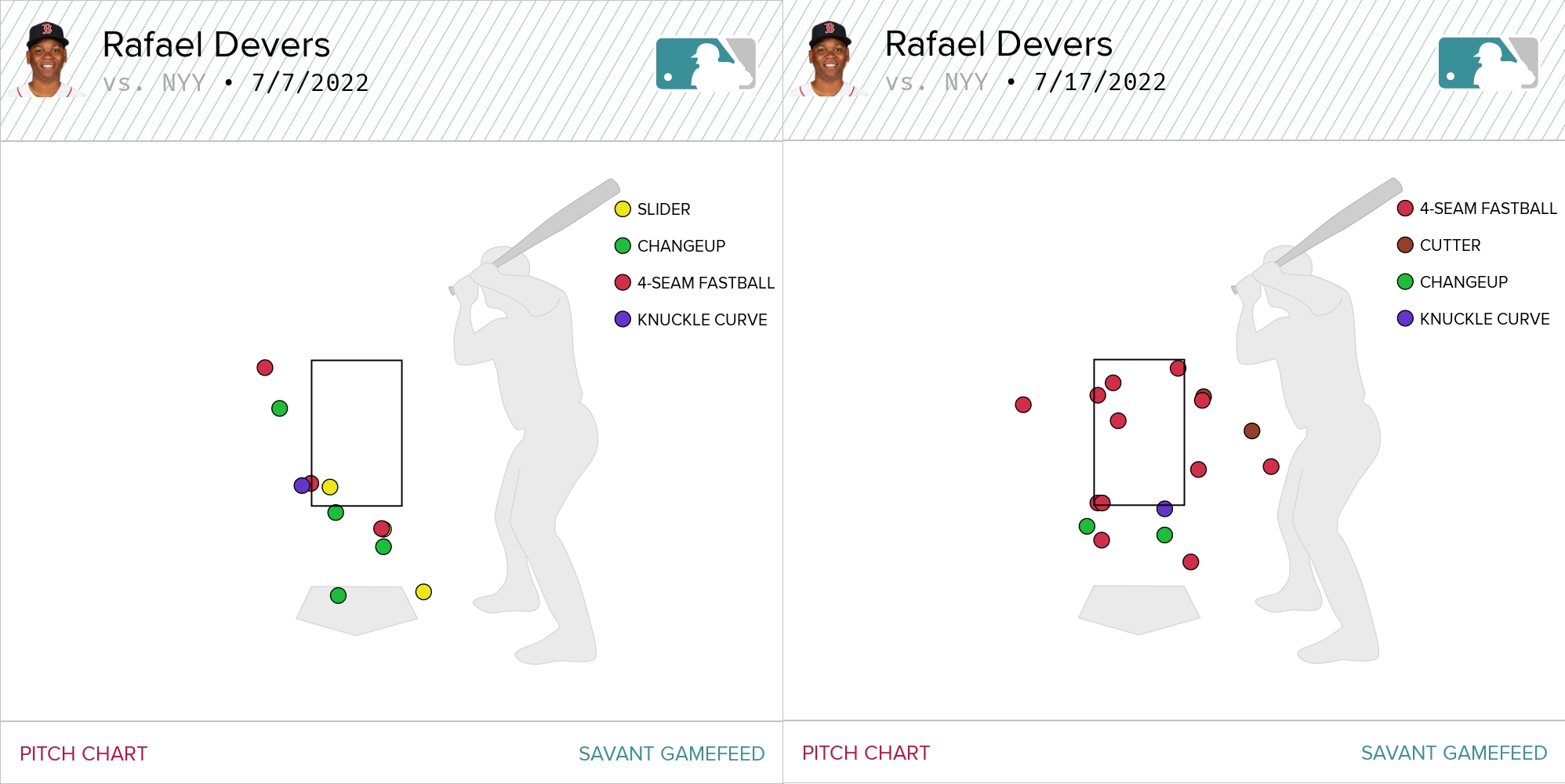
Gerrit Cole got Rafael Devers out! Three times, in fact. And wouldn’t you know it, he challenged him with fastballs. Cole threw soft stuff on the edges of the plate and Devers still took him deep twice two weeks ago. This past weekend 13 of the 16 pitches Cole threw Devers were fastballs. Look at the difference (full-size image):

The first pitch Cole threw Devers on Sunday was an inside fastball that made him jump out of the way and go down to the dirt. He didn’t throw at his head or between the numbers. If the pitch hit Devers, it would have hit him in the thigh or the behind. Cole made him move his feet and it had to be done. It was about time a Yankee made Devers uncomfortable in the box.
“I don’t think I figured him out,” Cole told Larry Fleisher after the game. “I think I just executed the pitches that I wanted to execute today, and I think we sequenced better than we did last time.“
Devers crushes fastballs and you can’t just lay them in there, but you also can’t be timid and try to dance around the plate and hope he gets himself out. That’s not what he does. He hammers everything. Cole tried soft stuff last time and it didn’t work. This time the plan was to be more aggressive with that triple digit fastball, and it worked. Next time they’ll probably have to do something else, but for at least one game, Cole and the Yankees got Devers out. Hooray for that.
Let’s close with some Triple-A Scranton housekeeping: Jose Peraza and Vinny Nittoli opted out of their minor league contracts over the weekend and are free agents. Peraza opting out explains bringing Tyler Wade back. The Yankees needed another Triple-A utility infielder. Neither Peraza nor Nittoli was performing all that great with Scranton:
The MLB injuries have thinned Scranton’s pitching staff. They have five starters (Waldichuk, Matt Krook, Clarke Schmidt, JP Sears, Hayden Wesneski) but the bullpen is basically Shane Greene and a bunch of fringe reliever prospects (Zach Greene, Greg Weissert, etc.). Eventually Richard Rodriguez will join the RailRiders. He’s still in Tampa building up and has yet to pitch in a game.
I expect the Yankees to pick up a depth arm or two leading up to the trade deadline. Nothing big. Just another guy like Greene and Rodriguez to fill the roster and soak up innings. Peraza has already been replaced. Now the Yankees have to find a Nittoli type to replace Nittoli.
(Send your requests for Friday's mailbag to RABmailbag at gmail dot com. The random Yankee series is on hiatus, but feel free to send in requests for when it returns.)
mike mousalis
2022-07-21 14:24:19 +0000 UTCMikeD
2022-07-20 05:04:42 +0000 UTCHigh Landers
2022-07-19 21:13:02 +0000 UTCDocBob
2022-07-19 20:01:54 +0000 UTCJeff in Canada
2022-07-19 19:22:58 +0000 UTCW.B. Mason Williams
2022-07-19 16:28:38 +0000 UTCBig Davey88
2022-07-19 14:51:58 +0000 UTCChris
2022-07-19 14:49:31 +0000 UTCI'm Not The Droids You're Looking For
2022-07-19 12:58:08 +0000 UTCI'm Not The Droids You're Looking For
2022-07-19 12:57:35 +0000 UTC