[COLUMN] Speak No Evil is a Study in the Art of the Remake | by Darren Mooney
Added 2024-09-16 14:00:13 +0000 UTC
NOTE: This article contains full spoilers for both versions of Speak No Evil - including details of both endings. Feel free to bookmark and come back. Christian Tafdrup’s version is streaming on Shudder now.
A very serious question hangs over the American remake of Speak No Evil: what is the point of this?
Of course, Hollywood has a long history of remaking international films, so a popular Danish horror movie seems like perfect fodder for such an adaptation. While there’s increasing evidence that American audiences are willing and able to transcend what Korean director Bong Joon Ho described as “the one-inch tall barrier of subtitles”, some of these remakes can be quite compelling on their own merits. Gore Verbinski’s The Ring might not be as good as the Japanese original, but it’s pretty good.
However, the bulk of the original Speak No Evil is actually in English. Like Anatomy of a Fall, it is about a culture clash between two European countries, so the bulk of the characters use English as a lingua franca. In Speak No Evil, Bjørn (Morten Burian) and Louise (Sidsel Siem Koch) are a Danish couple who befriend a Dutch couple, Patrick (Fedja van Huêt) and Karin (Karina Smulders), on holiday and decide to visit them in rural Holland, taking their daughter Agnes (Liva Forsberg). Each couple speaks their native language, but they communicate with each other through English.
Then again, Hollywood is constantly remaking classic movies that might feel dated or inaccessible to modern audiences. After all, the poster for the Speak No Evil remake proudly boasts that it is from “the producer of The Invisible Man”, another beloved remake. However, the Danish Speak No Evil is a very modern and accessible film. It was released in 2022, and is available to stream right now on the affordably-priced Shudder app. It is very easy to watch Christian Tafdrup’s original.
Ironically, while Christian Tafdrup’s Speak No Evil is easy to watch, it also seems difficult to adapt. While most of the dialogue is in English, language is a source of tension. Bjørn and Louise are staying with people who literally do not speak the same language. Unlike Bjørn and Louise’s conversations in Danish, Patrick and Karin’s native dialogue is not subtitled for the audience. This creates a sense of paranoia difficult to replicate if all four leads speak English as a native tongue.
While accessible to international audiences, Tafdrup’s Speak No Evil is a very European film even beyond its use of language. It tells a story about different cultures sharing a continent together, separate countries with fluid borders. In fact, it’s hard not to read a certain reactionary subtext simmering beneath the surface of Tafdrup’s Speak No Evil, which seems very attuned to anxieties bubbling through central European politics.
In the film’s closing minutes, it’s revealed that Patrick and Karin are serial killers preying on Bjørn and Louise’s civility. “Why are you doing this to us?” Bjørn asks Patrick. Patrick responds, “Because you let me.” Bjørn is not enough of a man to protect his family from Patrick, too tolerant of Patrick’s transgressions to recognize them as warning signs of an inherently violent nature. Bjørn refuses to set boundaries in the relationship between the two families, and it leads to disaster.

Patrick and Karin are assisted in this grim exercise by an immigrant named Muhajid (Hichem Yacoubi), who does not speak English. At the film’s climax, Patrick and Karin hold Agnes and cut out her tongue with a scissors. Muhajid shows up to drag Agnes out of the car, into her new life, while Patrick and Karin stone Bjørn and Louise to death by the side of the road. The film’s closing credits are set to overtly religious music and imagery.
Danish politics is dominated by debates around immigration, with a particular emphasis on Islamic immigrants. Over the past few years, Denmark’s left-leaning Social Democratic Party has embraced a hard line on the issue, with the country’s Muslim population reporting an increase in verbal abuse, exclusion and hate crimes. The Danish government has pursued a policy of aggressively assimilating such communities, contending that they “do not embrace Danish norms and values.”
Patrick and Karin are Dutch, but the horror within Tafdrup’s Speak No Evil is very strongly tied to fears about Islamic communities within Europe. The film’s ending reveals that Danish children are being abducted and coerced, recalling paranoia about Danish children being taught Islamic prayers. The decision to have Patrick and Karin stone Bjørn and Louise to death, a very distinctive mode of execution that evokes the fixation in Islamophobic rhetoric about “stoning people to death.”
In this sense, without directly evoking the Danish anxiety about Islamic immigrants outside of the involvement of Muhajid, Tafdrup’s Speak No Evil feels like a reactionary movie about “the paradox of tolerance.” Indeed, the film’s title alludes both to the graphic and literal silencing of Agnes and the more abstract polite self-censorship of Bjørn. Bjørn is too quick to excuse Patrick’s eccentricities as cultural differences rather than acknowledging them as red flags.
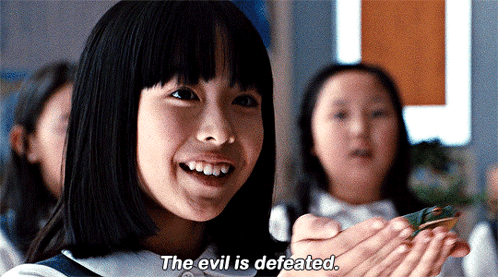
James Watkins’ remake of Speak No Evil is a much more American movie in its sensibility and outlook. This is obvious in the movie’s ending. In this movie, American immigrants Benny (Scoot McNairy) and Louise (Mackenzie Davis) are able to triumph over the villainous Paddy (James McAvoy) and Ciara (Aisling Franciosi). Watkins’ Speak No Evil roundly rejects the bleak nihilism of Tafdrup’s version, offering an affirming ending where Paddy’s head is smashed in with a rock. The evil is defeated.
Watkins’ Speak No Evil is a fascinating study in the art of adaptation. Most obviously, the film is very consciously in conversation with the Danish movie that it is remaking, to the point that it almost makes no sense outside of that context. Much was made of the fact that the remake’s trailer spoiled the ending of the original film, placing a heavy emphasis on scenes that are transposed directly from its source material. However, the film itself is in on the gag.

In Tafdrup’s Speak No Evil, there is a simmering tension that runs through the movie. The audience is squarely aligned with Bjørn and Louise, unsure whether the tension between the two couples is down to cultural differences or something more profound. In Watkins’ Speak No Evil, there is no real ambiguity, particularly in how McAvoy plays Paddy. It’s clear that Paddy is messing with Benny and Louise to see how much he can get away with. It’s performance. It’s role play. It’s almost sexual kink. He expounds to Benny about the thrill of the hunt. At the climax, another character mocks Paddy for “playing with his food.”
For its first two acts, Watkins’ Speak No Evil hits many of the same beats as the original, down to small details like Louise asking whether she should remove her shoes on arriving at the rural house. In its own way, the film serves to make the audience who have seen the original film feel just as uncomfortable as Benny and Louise; there is something uncanny about all of this, even as the finer details are the same. Something is fundamentally off, but it’s hard to pinpoint exactly what it is.
This shift is reflected in the tone. Tafdrup’s Speak No Evil was suffused with dread and ambiguity, effectively adopting the escalating tension of something like Karyn Kusama’s The Invitation. There is a deniability to the mounting horror, the possibility – however remote – that everything can be explained. In contrast, Watkins’ Speak No Evil pitches itself closer to a black comedy. The film never entertains any real doubt about Paddy and Ciara’s villainy, and so most of the tension derives from Benny and Louise repeatedly missing the clues while Paddy keeps pushing them.
Watkins’ Speak No Evil wisely moves away from the original’s reactionary subtext. Benny and Louise are Americans who have moved to England, visiting Paddy and Ciara in the West Country. The film introduces its own version of Mujhid (Motaz Malhees), but he is not part of Paddy and Ciara’s evil plan. In this version, their collaborator is a local restaurateur, Mike (Kris Hitchen). The tension here derives from the seething resentment that rural residents feel towards entitled urban liberals. The film’s British context makes sense for that shift.
To be fair, stripping out those specific reactionary anxieties allows Watkins’ Speak No Evil to focus even more heavily on the other themes of the original, particularly its fascination with masculinity. In Tafdrup’s original, Patrick drives Bjørn to a remote location so he can let out a primal scream, venting his frustrations about not feeling suitably macho. Watkins’ version recreates this scene, but doubles down on the point by placing Benny in the shadow of a very phallic war monument.
Watkins’ Speak No Evil leaves very little room for subtext or implication. It is explicit in articulating the finer particulars of Paddy’s psychosis, explaining that his serial killing is not only a financial scam but also a response to generational trauma. If any of their conversations with Benny and Louise can be taken at face value, Paddy and Ciara are effectively trying to create the family unit that both were denied as children. It feels a little reductive. It is basic pop psychology.
Tafdrup’s Speak No Evil conceals its big twists until the final ten or so minutes, but Watkins’ Speak No Evil foregrounds them. For audiences who have not seen the original, the remake aggressively hints at what Paddy and Ciara are doing. Their last victim, the mute Ant (Dan Hough), has an entire subplot in which he spells out their scheme to this version of Agnes (Alix West Lefler). Paddy and Ciara’s true nature is revealed at the end of the second act, with a full forty minutes to go.
The final act of Watkins’ Speak No Evil devolves into a horror riff on Home Alone, as Benny and Louise take shelter in the farmhouse while fighting off Paddy, Ciara and Mike. It’s a conventional and deeply silly slasher movie climax, elevated by the fact that the script is still having a great deal of fun with Benny’s masculine insecurities and that James McAvoy is a force of nature. It is a fundamentally different vibe from the bleak inevitability of Tafdrup’s ending, more action movie than arthouse.
Watkins’ Speak No Evil is an interesting illustration of the tension of the remake. Narratively, it hews very closely to the particulars of Tafdrup’s film, at least in its first two acts. However, this version is always aware that it exists in a different context. Watkins understands that the audience has probably seen the original, and so his film is in conversation with that. He also understands that mainstream American horror operates by different rules and logic than European arthouse cinema.
It's not necessarily that Watkins’ Speak No Evil is any better than the Danish original. Such an argument would be facile. Instead, it is distinct enough to justify its own existence. What more is there to say?
Comments
I wish i could describe myself as a casual movie fan, but I definitely don't go to theaters anymore. I intentionally don't watch trailers either for the reason you gave or they overshare any interesting parts. Great article Darren and appreciate your insights.
jahr
2024-09-16 22:08:53 +0000 UTCYep, and it was kinda like "Oldboy", in that you had a whole bunch of people who hadn't seen it hearing abotu it from friends who had seen it, boasting how messed up it was. (It was pretty messed up.) So, the novelty is oddly charming.
Darren Mooney
2024-09-16 21:50:36 +0000 UTCThis is interesting, and I guess exposes a difference between the experience of somebody like me (who is at the cinema multiple times a week) and the more casual movie fan (who doesn't go as regularly). I had been pounded with the trailer. Almost beaten into submission. And it was frustrating, because the trailer kinda *was* the original film, if that makes sense. So when the remake itself shifts the tone, it's oddly disarming and charming to me. Because part of the tension for me as a critic with the early black comedy is the worry that if this movie ends where the original did, the comedy is going to feel out of place. But instead, the film very firmly zags, and I... kinda admire that about it.
Darren Mooney
2024-09-16 21:49:28 +0000 UTCFun essay! It strikes me that making the remake less ambiguous was a natural step. The first movie already revealed the "twist" by virtue of being released, making it at least a little harder to keep the secret going.
William Alexander
2024-09-16 16:39:37 +0000 UTCThank you. Much appreciated.
Darren Mooney
2024-09-16 15:03:26 +0000 UTCThe original was disturbing to say the least. I didn't even know a new version was dropping until The Big Picture interview last week.
jahr
2024-09-16 15:03:25 +0000 UTCBrilliant article Darren. I am intrigued more and more by films I wouldn’t have seen or heard of through your writing. Thank you for what you’re doing. It’s truly fascinating.
Sunshine & Roots
2024-09-16 14:25:08 +0000 UTC