[ As always, don't flip through the image carousel if you don't want spoilers. ]
That main image up there is my little mirror trick for checking my drawings.
For artists working digitally, an easy way to "check" your work is to flip it horizontally. Left becomes right and right becomes left. Your character faces the opposite direction. This can reveal a whole host of issues that you might not have seen while you were actually drawing the image.
Sometimes I'll be drawing something (this happens most often with characters, I find) and I'll think, "this doesn't look quite right." I'll flip or mirror the drawing and all of a sudden it will become clear: "oh, one of the eyes is sticking way out to the side." Sometimes I'll be drawing something and thinking, "this looks great," and then I'll flop it and, uh oh, turns out it does not, in fact, look great. More on this below.
If you don't spend much time drawing, that might sound strange, and I'm not going to pretend it makes a lot of sense to me, but I while you're drawing, I guess your brain "gets used to" what it's seeing. By flopping or mirroring the drawing, your brain sees it anew and is more easily able to be objective about it.
FOR EXAMPLE
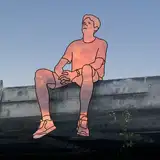
I thought I absolutely nailed this panel.

[ ^ Fig. A ]
It came out so easy. I sat, I drew it, I finished, I thought "NAILED IT."
Because I was so pleased with it, just now I took a photo to share with you guys, to say "look at this panel I absolutely smashed on the first try."
Except, when I loaded it into Photoshop, I noticed the whole drawing had a pronounced skew to it. Below, two images: the drawing as it was photographed (Fig. B), and that exact same image, but mirrored, or "flopped" as we often called it in animation (Fig. C).

[ ^ Fig. B and C ]
Looking at the flopped version (C), I can see the whole thing looks like you're looking at it on an angle. Actually, the specifics of HOW it looks wrong don't matter, the interesting thing is that the flopped one looks absolutely broken to me while the original (B) does not.
Here's the panel in its original orientation, but I've given it a sharp skew. (This is the exact same image as Fig A.) Notice the slant on the panel borders. There are still things about dad's figure that I want to change, but it looks a lot better, IMO.
[ ^ Fig. A, again ]
Since I'm not pencilling digitally, I can't easily flop a drawing.
This is where the mirror comes in.

If I turn my paper upside down and look at my drawings reflected in the mirror, it's essentially the same as flopping the image. When something looks wrong, or when I have a hunch that "something's off," I'll check the drawing this way. Sometimes I'll try to actually draw while looking at the mirror. This is not often successful.
Unfortunately, this whole technique relies on me noticing that something is wrong. If I don't, if I think, "NAILED IT," I'm not going to check, and I have to wait until a later stage to realize the panel is broken. And I'll tell you, that's not a fun feeling, thinking "I am proud of this," then later realizing, "oh wait, no, maybe not."
But! All those OBVIOUSLY bad panels? I AM DESTROYING THOSE. They are SHATTERING under the scrutiny of my mirror. And I gotta say, on the whole, I am so happy with how Chapter Four is turning out. Very excited for this.
- - - - -
Just a short post this week on account of if I get drawing right now I can pencil a whole page before preschool lets out!
Until next week,
I remain,
flipping and flopping,
TC
Tony Cliff
2023-10-13 18:04:34 +0000 UTCTroy Fischnaller
2023-10-06 13:33:47 +0000 UTCTealin
2023-10-06 09:28:16 +0000 UTC