PSA: Next week’s post schedule will be a little wonky because the draft begins Sunday and it’s the All-Star break. I’m thinking a first half review-y post Tuesday, a single dedicated draft post Wednesday, and then a second half preview-y post before the Astros doubleheader Thursday. Sound good? I’m not 100% committed to that plan, so no promises, but that’s what I’m thinking right now. Let’s get to today’s post.
1. Weekday thoughts. The Yankees are now a perfect 2-0 this season when their starter gives up back-to-back-to-back home runs. Let’s try not to make it 3-0, okay? I was hoping for a nice and easy series against the Reds so I could skip the weekday thoughts and instead focus on other stuff, but nope, it was the Yankees that looked like the team barreling toward 100 losses these last three days. The Yankees are 1-4 in their last five games and 6-7 in their last 13 games dating back to the start of the road trip. Here are a few thoughts on the last few games.
The Yankees were extremely unlikely to continue getting 95% of their starts from their top five starting pitchers, and the inevitable injury has arrived. Luis Severino exited Wednesday’s game with what the Yankees called shoulder tightness. Severino said he woke up tight, was unable to loosen up during warm-ups, told the Yankees he was tight after the first inning, then was sent out to give up back-to-back-to-back home runs in the second and throw a warm up pitch before the third before finally pulling himself from the game. In other news, Aaron Boone is probably the favorite to win AL Manager of the Year.
‘When I talked to him after the first inning, he was just a little leery of letting it go,” Boone told Greg Joyce after the game. “But he kept saying, ‘I feel really good.’ Something was telling him to hold back a little bit. Sometimes he can be that way a little bit early where he’ll ease into it a little bit. I think in his mind, with his injury history, he gets a little cautious.”
I feel like “he was just a little leery of letting it go” and “something was telling him to hold back a bit” are at odds with “I feel really good,” but what do I know, I’m just a big dumb idiot. Anyway, we didn’t need the back-to-back-to-back homers to know something wasn’t right with Severino. His velocity was way down …

… and he didn’t have the usual bite on his slider, and he just didn’t look comfortable on the mound. He was putting everything he had into each pitch to get to that reduced velocity too. That’s never good. Severino went for an MRI on Thursday and the Yankees are calling it a “low grade lat strain.” He’s on the 15-day* injured list.
* Yes, it’s back to a 15-day injured list for pitchers (and only pitchers). That’s one of the rule changes that was supposed to kick in a few years ago but kept getting pushed back by the pandemic. It’s a thing now. It started with the 13-pitcher limit a few weeks ago.
Hopefully the lat strain truly is “low grade” because lat strains can be season killers. Severino had a Grade 2 lat strain in April 2019 and didn’t return until September. He’s up to 86 innings this season after throwing 39.1 innings total from 2019-21. With any luck this is just his body saying “hey, I need a break, this is a lot of work,” and he comes back good as new in two weeks.
Even if Severino comes out of this okay, the baseball gods just sent the Yankees a warning shot, and they should look for rotation help at the deadline. And not just a back-end innings guy either. Get someone who can start in the postseason. Jameson Taillon and Nestor Cortes are coming back to Earth and now Severino’s hurt. The cracks in the dam are beginning to show.
Thanks to the All-Star break Severino might only miss one start. The Yankees will need someone to make a spot start next weekend, then Severino could return to fill the rotation spot the next time around. Hopefully that happens, but under no circumstances should the Yankees rush him. Severino is too important and his injury history necessitates caution. The big division lead means the Yankees can exercise it.
Clay Holmes is in his first rut as a Yankee. It happens to even the best relievers. Every year we had What’s Wrong With Mariano? Week™ once in April and once again in August. Josh Hader has allowed six runs in his last four innings and five appearances. This stuff happens during the long season. Still, it’s shocking when a guy as dominant as Holmes suddenly looks mortal.
“That can’t happen. I gotta be a little better at making some in-game adjustments,” Holmes told Greg Joyce following Tuesday’s loss. “There was a couple pitches that the sinker just didn’t feel right, and I think I just started to let myself lose some direction there. Once that happened, it was really hard to right the ship. Just a ton of uncompetitive pitches.”
This Holmes slump is a bit worrisome because his control has deteriorated. If he got beat because a bunch of ground balls found their way through the infield, then who cares. Sucks but that’s baseball. But Holmes has lost the handle on his sinker. He sprayed it all over the place in his two appearances against the Reds. His pitch locations in those two outings:

In those two outings Holmes walked two and hit two – that’s four free baserunners in two innings after Holmes allowed four free baserunners in his previous 33.1 innings – and went to at least a 2-0 count on three other batters. And it’s not like Holmes was just missing off the plate. You can see the graph. He had pitches sail way up high and also nosedive into the dirt.
Holmes became a lockdown reliever seemingly overnight because the Yankees got him to trust his sinker and really pound the zone with it. He had a 14.9% walk rate with Pittsburgh, then came over to the Yankees and instantly became an extreme strike-thrower (4.6% walks). Walks are only part of the story though. Holmes’ zone rate was way up. Now it’s way back down:

“I know (pitching coach Matt Blake) and him were in there earlier talking about some things they identified just with his posture and mechanically that they were both like, ‘yeah, that was the difference,’” Boone told Laura Albanese on Wednesday. “And he just wasn’t able for whatever reason to kind of make that adjustment on the mound (Tuesday).”
It goes without saying Holmes reverting back to Pirates Holmes would be disastrous, but I don’t think we’re close to panic time yet (I get being a little nervous given Holmes’ short track record as a dominant reliever). Holmes is smart and has shown he can make adjustments. Waiting for a high leverage reliever to right the ship is never fun, but two appearances is at worst a yellow flag to me. We’re not in red flag territory yet.
“It wasn’t quite there (Wednesday), especially early on. As the inning went on, I started to get that feel back,” Holmes told Jared Greenspan. “... The closer’s role, there is some responsibility with that. But at the same time, you give up runs, it’s never what you want. You just have to try and learn from it and move on.”
He hasn’t returned to the lineup yet but it sounds like Aaron Hicks avoided major injury when he fouled that pitch into his shin Tuesday. He had to be helped off the field and thankfully x-rays and a CT scan showed no fracture. A few years back either Ken Singleton or Paul O’Neill (I don’t remember which one) told a story that they once fouled a pitch into their shin in April and still felt it in September. I can buy it. Those direct hits are painful. Hicks isn’t out of the woods yet (like I said, he hasn’t returned to the lineup), but the news so far is good. A Hicks injury would change the trade deadline calculus a bit … In addition to being awesome in general, Mike King is an extra innings maestro. He has thrown five extra innings with the automatic runner this season and four of the five were scoreless, including Wednesday. The one run he did allow in extras came in the tenth inning on Opening Day, so King has stranded the automatic runner in his last four extra innings. Here’s a fun leaderboard. This is extra innings pitched in 2022:
We are just about at the All-Star break and King owns a 2.23 ERA (2.20 FIP) in 48.1 innings. I hope he gets to go to the All-Star Game as a replacement. I also hope the Yankees can back off him a bit in the second half because he’s on pace for nearly 100 innings. I know he’s been a starter throughout his career, but 100 innings as a high leverage reliever is much different than 100 innings as a starter with a set schedule and a routine … Jonathan Loaisiga returned Thursday and looked like a pitcher who could have used another rehab outing or two. His velocity was there and he didn’t give up any real hard contact (he did give up a double-hit ball though), but he missed his spot a ton and didn’t get a single swing and miss among 24 pitches (11 swings). Why the Yankees threw him right into a high leverage spot, I do not know. The Yankees are gonna need a reliever at the deadline. Loaisiga and Aroldis Chapman haven’t been right all year and Albert Abreu and Ron Marinaccio (and Zack Britton?) can’t be the answer … Is Miguel Castro hurt or something? He’s pitched twice since coming off the paternity list nine days ago and he didn’t appear in the Reds series at all – Lucas Luetge faced five righties in the tenth inning Thursday – even though the Yankees needed their bullpen a ton. If Boone doesn’t trust Castro, fine, I get it, but he needs to go sooner rather than later in that case. Weird he didn’t pitch once against a righty heavy lineup in the Reds series … And finally, how about that Luis Castillo guy? I’m not greedy, the Reds can keep him for the next few days and enjoy watching him pitch in the All-Star Game. But yeah, that guy needs to be in pinstripes in two weeks.
2. Trade deadline rumors. T-minus two weeks and four days until the trade deadline, and just as a reminder, there are no August waiver trades anymore. The last few years have been kinda weird and it’s tough to keep track of which rules stayed and which rules went away. Aug. 2nd is the last chance to make a trade to improve the team. Here are a few deadline nuggets.
The Royals are in Toronto for a four-game series this weekend and they had to place 10 – 10! – players on the restricted list before making the trip. The list includes four outfielders and their two healthy catchers (Sal Perez is hurt). Among those placed on the restricted list is possible trade target Andrew Benintendi, and yeah, not being able to play in Toronto is kind of a big deal.
The Yankees have just one regular season series remaining in Toronto: Sept. 26th to 28th, the third-to-last series of the year. That series shouldn’t matter from a “we need to win to make the postseason” perspective, but the Yankees could still be battling for the best record in baseball and thus home field advantage throughout the postseason. They want that. I want that.
Also, the Yankees could play the Blue Jays in the postseason, and any trades they make at the deadline will be geared toward October, not August and September. Being available for all possible postseason games is part of that. Benintendi could get vaccinated between now and then, but as of right now, he can’t play in Toronto. This is a deal breaker, right?
I’ve been kinda souring on Benintendi as a trade target (don’t get me wrong, I’d rather have him than the current version of Joey Gallo) mostly because he’s not hitting for any power, and I don’t want to risk a BABIP lull and have him turn into the outfield version of Isiah Kiner-Falefa. Being unable to play in Toronto is another reason (and a pretty good one) to look elsewhere.
Kristie Ackert recently reported the Yankees and Royals were having “ongoing” trade talks about Benintendi the last few weeks, though the asking price is high. I gotta think the vaccination thing has halted talks. So, this is a rather significant development on the ol’ trade deadline circuit. One of the most readily available rental players can’t play against an AL East rival.
(The Blue Jays were said to have interest in Benintendi in recent weeks. Gotta think that’s off the table now. Also, the Yankees have been loosely connected to Michael A. Taylor the last week or so. He’s another Royal who couldn’t go to Toronto and is on the restricted list.)
(Not gonna lie, I got a laugh out of Whit Merrifield saying he would get vaccinated if he were on a good team that had to go to Toronto for the postseason.)
The Yankees have been scouting Diamondbacks outfielder David Peralta as a “fallback option,” according to Bob Nightengale. I answered a mailbag question about Peralta a few weeks back. The 34-year-old lefty swinger owns a .236/.303/.440 (101 wRC+) line, including .255/.312/.477 (112 wRC+) against righties. Peralta clears the “better than Gallo” bar.

(Is Peralta really as good defensively as OAA says? I don’t watch enough D’Backs games to form an eye test opinion about his glove. OAA has loved Peralta’s defense the last few years. DRS sees him as closer to average in left field. Huh.)
“We are getting a lot of calls on this group, frankly,” D’Backs GM Mike Hazen told Nick Piecoro about his outfield last month. “Other teams see they are good young players and we have a decent amount of them, and we’ve told other teams we’d be open to discussing these guys.”
Peralta is making $7.5M this year and will be a free agent after the season. Arizona is bad (39-50 and eight games out of a postseason spot) and loaded with young outfielders. Peralta is on the way out, either at the deadline or after the season. With Benintendi making himself a less desirable target, I reckon interest in Peralta will increase a bit.
The D’Backs have a history of salary-dumping rental veterans when they’re out of it (Archie Bradley and Robbie Ray in 2020, most notably) and I bet you could get Peralta for a Grade-C prospect. Maybe less. He’s an average-ish player and the D’Backs’ priority is clearing payroll and a roster spot. I’d like the Yankees to aim higher, but as a “fallback option,” yeah, Peralta works.
In the least surprising news ever, the Yankees are “conducting discussions” with multiple other teams about Gallo, according to Jon Heyman. The Padres and Rangers, the teams that know Gallo the best, are thought to have interest (Padres GM AJ Preller was in the Texas front office and overlapped with Gallo for a bit, and is known to love him).
Trading Gallo back to the Rangers for a fraction of what you gave Texas to acquire him last summer would be rather humiliating, but I also don’t think Brian Cashman cares. He gave the Red Sox a prospect to take Adam Ottavino last year and that worked out poorly. Cashman doesn’t seem to care about public perception. He’ll do what he thinks is best.
I have no idea how to value Gallo. He’s having a terrible year but might also hit 20 homers after the deadline if this is truly a “he can’t handle New York” thing and not a “his margins are razor thin because he makes so little contact” thing. Gallo is a good defender and not a total zero because of it, but if he’s not hitting, he’s tough to keep running out there.
I don’t expect the Yankees to get much for Gallo but I also think they’ll wind up getting an actual prospect in return. Maybe that’s just me being optimistic. The most important thing is the Yankees find at least two teams to compete for him to create some leverage. The Phillies could have interest. Maybe the White Sox. Maybe even the Cardinals?
Last weekend Cashman told Brendan Kuty the Yankees haven't honored Miguel Andujar’s trade request because they value him as depth (there is no official way to request a trade and the Yankees are not obligated to trade him). Andujar has requested a trade since at least the end of last season. Maybe even before that. He’s hit .321/.364/.505 (130 wRC+) with eight home runs and a 12.1% strikeout rate through 48 Triple-A games this year.
“I don’t ever look to trade somebody because they ask to be traded,” Cashman told Kuty. “He’s a member of this organization and someone that we value and we benefit from having. But obviously if something made sense, we’d do something. But, obviously, clearly at this point, we feel like he’s more valuable to us than me doing anything that has been presented to me up to this point anyway.”
On one hand, the GM won’t come out and say we’re trying to trade this guy. You have to play hard to get to get maximum value. On the other hand, yeah, Andujar probably is more valuable to the Yankees as depth than anything he’d bring back in a trade. Josh Donaldson and Giancarlo Stanton are known to frequent the injured list. One injury and Andujar’s back in the big leagues.
Injuries are the only way Andujar will get another opportunity with the Yankees as anything more than the 27th man in a doubleheader. They’re pretty much done with him, but they shouldn’t just give him away either. The priority should be winning the World Series this year and Andujar is better than most guys who occupy what, the 34th or 35th spot on the 40-man roster?
Tyler Wade is back. The Yankees acquired Wade from the Angels for a player to be named later or cash earlier this week. He’s not on the 40-man roster (Wade cleared waivers and was outrighted earlier this month) and is going to Triple-A Scranton. Wade hit .218/.272/.272 (57 wRC+) in 163 plate appearances with the Angels before being dropped from the roster.
“We know Tyler. We know what he brings to the table. He can play all the outfield positions, can play all the infield positions. He's a bolt of lightning on the base paths. He can steal bases for you," Cashman told Andy Martino. "So I thought he was a good organizational depth, so now we have more choices. We're better protected as we start to navigate the rest of July, August and September, and hopefully October. And I think we're a stronger, better organization today than we were yesterday because now we have more coverage.
Normal brain: Wade is a minor pickup who gives the Yankees more middle infield depth, nothing more and nothing less. Galaxy brain: Wade gives the Yankees a new Triple-A shortstop so they can trade Oswald Peraza at the deadline. The former is very likely what’s happening here (I’m pretty sure Anthony Volpe would just get bumped up to replace Peraza anyway).
The Yankees are really getting the band back together this year, huh? Manny Banuelos, Shane Greene, and Greg Bird have all spent time in the farm system. The Yankees tried to sign Rob Refsnyder too. Now Wade’s back. Who’s next, Chase Whitley? Laugh if you want, but bringing back prospects of yesteryear is how the Yankees landed All-Star Nestor Cortes.
3. Scouting the Trade Market: Amed Rosario. The trade deadline is two weeks and four days away and, as good as they’ve been, the Yankees need reinforcements. An outfield bat is a must, pitching depth is never a bad idea, and a new shortstop would be great because let’s face it, Isiah Kiner-Falefa has not impressed. On either side of the ball.
Finding a quality shortstop at the trade deadline won’t be easy. By FanGraphs WAR, 13 of the 16 best shortstops in baseball play for contenders and are unlikely to be traded. The other three:
Among those top 16 shortstops in FanGraphs WAR, the one most likely to be available is Amed Rosario, the Mets-turned-Guardians shortstop-turned-outfielder-turned-shortstop again. Once an elite prospect (there was a Rosario vs. Gleyber Torres debate back in the day), Rosario has settled in as a good player more than a great player, though at 26, you can still dream on him a bit.
The Guardians are 44-44 and yet they’re only two games behind the third Wild Card spot. They are very much in the postseason race. They’ve also shown they will trade core players while in the race to keep the pipeline flowing. Consider these recent deals:
Cleveland’s problem is not identifying or developing talent. Ownership is just cheap. They’ve cut nearly $70M off payroll since 2018 (the cuts started before the pandemic) and this year’s $63.2M Opening Day payroll was fourth smallest in baseball. The small payroll forces the front office to make difficult decisions, like trading important players in the middle of a postseason race.
Rosario is making decent money and he’s only a year away from free agency, so the question is not will the Guardians trade him, it’s when will the Guardians trade him (neither Clevinger nor Bauer was traded as a rental, I should note). Could he make sense for the Yankees? Let’s look.
As noted, Rosario is making decent money and he’s only a year away from free agency. He’s making $4.95M this season, so trade for him right at the deadline and you’re absorbing roughly $1.6M in salary and luxury tax obligation. That works for a Yankees team that is approximately $7.8M under the $270M third luxury tax tier, per FanGraphs. Rosario figures to make $8M or so through arbitration in 2023, then he’ll become a free agent.
Clean. Rosario spent four days on the COVID list last September and has otherwise never been on the injured list as a big leaguer. He did miss three weeks with a wrist injury while in High-A in 2015. That was so long ago that I wouldn’t worry about it at all. Healthy as a horse, this one.
Early in his career Rosario was a major liability at shortstop, and there were constant rumors the Mets would move him to the outfield to make better use of his speed. That never happened in New York. It did happen in Cleveland though. Rosario played 45 innings in left and 123.1 innings in center last year, and it went poorly enough that the Guardians put him back at shortstop.
I assume the outfield is off the table now, and Rosario has never played second or third bases. He’s a shortstop, through and through. Here are his shortstop numbers:
2017-20 DRS: -20 in 3,306 innings
2021-22 DRS: -6 in 1,650 innings
2017-20 OAA: -34 in 3,306 innings
2021-22 OAA: -4 in 1,650 innings
Two things are true: a) Rosario is still a below-average defender, and b) he is way better defensively than he was earlier in his career. He went from -6 DRS and -10 OAA per 1,000 innings from 2017-20 to -4 DRS and -2 OAA per 1,000 innings from 2021-22. Not great, but adequate. I can overlook these defensive shortcomings as long as there are enough other things to compensate.
The outfield stint is not something that increased Rosario’s versatility. It was an experiment and it failed, and it’s (probably) not worth revisiting. Trade for him and you’re getting a shortstop, not a shortstop who can also play the outfield. I see Rosario as a one-position player.
Like many young players, Rosario was a wild horse on the bases earlier in his career. He was aggressive and reckless. Now that he’s gained experience, Rosario is a smarter and more efficient runner, though he’s not a high volume base stealer. He’s 22-for-25 (88%) stealing bases the last two years. Some other numbers since Opening Day 2021:
Rosario is very fast (he leads baseball with five triples, for what it’s worth) and he uses his legs well. He adds real value on the bases and would bring a speed element the Yankees currently lack, even with their baserunning improved overall.
Rosario’s offensive game is very Andujarian. He’s a free swinger who makes a lot of contact, so he's a low strikeout/low walk hitter rather than a high strikeout/low walk hitter. Rosario lacks over the fence power though. He’s averaged 11.3 homers per 600 plate appearances in his career, and his career best 15-homer season came with the rocket ball in 2019.
Here are Rosario’s platoon splits since Opening Day 2021. He’s a righty who punishes lefties and at best holds his own against righties:

Rosario has smacked a few balls north of 110 mph over the years (almost all his power is to the pull side) but, by and large, he is not an exit velocity guy, and we know the Yankees value exit velocity. Rosario’s contact quality this season is essentially identical to his career numbers:
The Statcast profile shows a man of extremes. The things Rosario does well, he does very well, and the things Rosario does poorly, he does very poorly. For all intents and purposes he is a high contact/low power and high speed/low defense player.

The Yankees value exit velocity but are willing to deviate if they like the player, which is how they wound up with Kiner-Falefa. Kiner-Falefa is not the best argument against exit velocity, but others around the game show you can be productive without premium hard-hit ability. Jeff McNeil is the gold standard “great hitter with bad exit velocity” guy.
There aren’t many good trade benchmarks for Rosario, a good but not great player with 1.5 years of control. Joey Gallo and Starling Marte (Diamondbacks to Marlins) were traded with 1.5 years of control, though they were established players with All-Star Game selections and all that. Rosario is not that. He’s still something of a developing player.
In their recent core player trades the Guardians sought quantity over quality packages that included at least one player ready to step right onto the MLB roster. The notables:
It stands to reason Cleveland will want an MLB ready player in return for their shortstop (Gimenez could slide over to play short). What does that mean for the Yankees? I’m not sure. I could see the versatile Oswaldo Cabrera interesting the Guardians. The Yankees have a lot of pitching to offer too (JP Sears, Hayden Wesneski, etc.).
We are talking about Amed Rosario here, not Lindor, so the package shouldn’t be anything that really hurts. Offensively, Rosario is a better version of Kiner-Falefa as a high contact guy who can actually hit the ball out of the park once in a while, plus he’s a better runner. Kiner-Falefa is the better defender, though the offensive upgrade is larger than the defensive downgrade.
Rosario was once an elite prospect (as in a consensus top 10 guy) and he will play the entire season at age 26. He is entering what should be his prime and sometimes it takes these guys a little while to find their footing. Fellow 2017 top prospects JP Crawford and Dansby Swanson are just now starting to really put things together. It’s not crazy to think Rosario’s best is still to come.
I don’t think the Yankees are outright replacing Kiner-Falefa. They believe in him and want him to be their shortstop, so I think Rosario is a long shot even though he would be an upgrade. I would rather have Rosario than Kiner-Falefa, but I think Joey Wendle is a more realistic target as a lefty swinging infield complement who provides more versatility.
4. Thoughts leading into the 2022 draft. The three-day amateur draft begins Sunday night and it won’t conflict (much) with actual games. The draft begins at 7pm ET and the day’s final games begin at 4pm ET. The Yankees and Red Sox will begin their series finale at 1:35 pm ET, so figure they’ll be in the fifth or sixth inning when the draft starts.
I appreciate MLB’s efforts to market the draft, but it is not a made-for-TV event like the NBA and NFL (and even NHL) drafts. College baseball is not nearly as popular as college basketball and football, plus these players disappear into the minors for a few years after being drafted. Fans rarely see their team’s first round pick in big league games the next season.
Anyway, here are the Yankees’ picks and bonus slots one more time, and here is the full draft order. The Orioles have the No. 1 pick for the second time in three years. The Yankees will make their first and second round picks Sunday, their third through tenth round picks Monday, and then all their remaining picks Tuesday.
1st round: 25th overall ($2,879,300)
2nd round: 61st overall ($1,187,000)
3rd round: 100th overall ($611,100)
4th round: 130th overall ($456,300)
5th round: 160th overall ($340,500)
6th round: 190th overall ($263,800)
7th round: 220th overall ($207,300)
8th round: 250th overall ($172,200)
9th round: 280th overall ($157,900)
10th overall: 310th overall ($149,700)
11th to 20th rounds: Every 30 picks thereafter (every dollar over $125,000 given to a player drafted after the 10th round counts against the bonus pool)
“It’s completely about taking the best available player,” scouting director Damon Oppenheimer told Bryan Hoch. “In the amateur world, you can’t stop taking the best. You’re not trying to take somebody because you’re short on a position or you have too many. If you don’t want to take a guy (who is the best available player), you’re going to get yourself in trouble.”
Nick Swisher will again represent the Yankees at the draft (maybe he’ll get another bro/Breaux moment). The Yankees’ bonus pool is $6,425,100. Add in the 5% overage before the harshest penalties kick in and they can spend $6,746,355 on draft picks this year. Here are all the draft prospects I’ve profiled and here are a few final thoughts heading into the draft.
In his latest mock draft Keith Law (subs. req’d) said he’s “heard (the Yankees would) love to get” Michigan HS RHP Brock Porter. Every single scouting publication currently ranks Porter as the best healthy pitcher in the draft class, and mock drafts have had him coming off the board as early as No. 9 overall to the Royals. Getting him at No. 25 feels like a pipe dream.
But! But high school pitchers fall more than any other prospect type, and every year a few of the best fall out of the first round and either wind up going to school, or getting an overslot bonus from a team with extra picks. It’s unlikely Porter will be available at No. 25 but not impossible, and if he does get there, it would presumably take some bonus pool gymnastics to get him signed.
Here’s some video and here’s a snippet of MLB.com’s free scouting report. They rank Porter as the No. 11 prospect in the draft class.
Porter has the best fastball in the high school crop, sitting at 94-97 mph for innings at a time, topping out at 100 and generating that velocity and plenty of armside run and carry with relative ease. He also owns one of the better changeups in the Draft, as he throws his with deceptive arm speed, good velocity separation in the low 80s and outstanding horizontal action. He has made encouraging progress with his slider this spring, flashing some plus slide pieces as hard as 87 mph, and he'll mix in a downer curveball in the upper 70s.
Other than continuing to refine his feel for spin, Porter doesn't need much beyond experience and continued good health. He has a strong 6-foot-4 frame with some projection remaining, repeats a delivery that features little effort and provides plenty of strikes.
Getting the draft’s consensus best healthy pitcher would be a huge win at No. 25. I think there’s a chance Porter and his representatives are using the Yankees to drive up their price, and hey, that’s cool. The more another team pays him, the less they can spend on other players, and the better it is for the Yankees. It potentially opens some avenues for them, in theory.
I don’t want to get my hopes up – there are probably 15+ teams that would “love to get” Porter – but I did want to mention the rumor, and note there is a path to Porter falling to the Yankees. It’ll take an overslot bonus and some luck, but it’s not impossible. More likely, he’ll go to another team before the Yankees pick. Team wants good pitching prospect. News at 11.
I’ve heard a lot of buzz about the Yankees and Vanderbilt OF Spencer Jones lately. Here’s my profile. Jones excites statheads (good exit velocity and swing decisions) and scouts (great athleticism and physicality) alike, though there are a few things in his swing that must be cleaned up. Trey Sweeney showed us the Yankees don’t consider that a deal breaker. I don’t know if the Yankees have zeroed in on Jones as their guy at No. 25, but I do know they really like him.
I don’t have a favorite draft prospect this year. Occasionally I’ll fall in love with a player and hope the Yankees draft him, then they don’t and he flames out elsewhere because I’m an idiot. I don’t have one of those players this year. I like Oklahoma RHP Cade Horton (my profile) and would like the Yankees to draft him, though I wouldn’t be heartbroken if it doesn’t happen.
(Word on the street is the Braves are targeting Horton with the No. 20 pick, and they made that trade with the Royals to get the No. 35 pick earlier this week to make sure they have the bonus pool space necessary to meet his asking price. Horton is said to want $4M or so.)
I’m also a fan of East Carolina SS Eric Brown (my profile). Nothing about him looks natural (he’s got a very big bat wrap at the plate) but he barrels up everything, and I know a few analytically inclined teams want him, particularly the Astros. I never did fall in love with a draft prospect this year though. Horton or Brown would be neat, but I’m not hoping for any player in particular.
Each spring I cobble together a list of draft prospects to profile that I add to and subtract from constantly. I never get to everyone and one player I like but didn’t get to profile is Missouri JuCo RHP Jacob Misiorowski. He’s a personal favorite. Here’s video and here’s a chunk of his MLB.com free scouting report (ranked No. 78 in the draft class):
Fully healthy again (after a torn meniscus last spring), Misiorowski has hit 100 mph with his four-seam fastball and sat in the mid-90s for several innings at a time. His extension, high spin rates and induced vertical break create carry up in the strike zone, and he might find even more velocity if he can add some muscle to his skinny 6-foot-7 frame. His mid-80s slider features good depth and is a well above-average offering at its best, though it's more of a chase pitch than one he can land consistently for strikes.
Very much a work in progress, Misiorowski primarily operates with two pitches and rarely breaks out a curveball or changeup … He started finding the zone more often down the stretch and helped his cause with the most impressive bullpen workout at the MLB Draft Combine
A very tall, very hard-thrower who is still very young (turned 20 in April) seems like a great ball of pitching clay for the player development folks. Jim Callis recently said the Dodgers have interest in Misiorowski, and if that club is interested in a prospect, there’s probably something there. If the Yankees go the “safe” college bat route in the first round again, Misiorowski in the second round would provide nice balance with his upside.
The first round gets all the attention but the middle rounds are where you build organizational depth, and the Yankees have done very well in the middle rounds the last few years. The pattern is bats early and build-a-pitcher prospects later. From the last few years (the Yankees only had three picks in the five-round 2020 draft, remember):
All the attention is on the first round and understandably so, but the Yankees will grab a few random college arms on Day 2 of the draft, and a year from now we’ll be talking about them as breakout pitchers and trade chips. It’s what the Yankees do. They identify pitchers with arm talent and adaptability, make some tweaks, and watch them take off.
(Which build-a-pitcher prospects could the Yankees take in the middle rounds this year? Beats me. I try to limit my draft knowledge to the top 50-60 players and the Yankees pluck dudes out of mostly small colleges and turn them into actual prospects.)
5. Rapid fire thoughts. So long, Greg Bird. Earlier this week the Yankees released Bird (and David Freitas), and I guess that clears a Triple-A roster spot for Tyler Wade. Now 29, Bird hit .218/.325/.354 (85 wRC+) with six homers and a 25.4% strikeout rate in 59 Triple-A games. For a bat-only player, that’s terrible. Bird might hook on elsewhere for the rest of the season, but he may be nearing the end of the line. He hasn’t played in the big leagues since 2019 and didn’t do anything in Triple-A the last two years to make you think there’s still life in his bat. Best of luck, Birdie … Alas and alack, Giancarlo Stanton will not participate in the Home Run Derby. That's too bad. I was looking forward to watching him hit balls over the pavilion. Here is the Home Run Derby field:

Aaron Judge and Gary Sanchez in 2017 were the last Yankees in the Home Run Derby. They'll get someone in there again one day. I think. Probably ... Not surprise here: Tim Casey reports the Yankees are working with a firm to find a jersey ad sponsor for next season. The Padres are the only team to announce a jersey ad deal so far. The Lakers signed a five-year, $100M jersey ad deal last year and that's for an 82-game season. I imagine the Yankees are seeking something in that neighborhood, if not more. Also, buried in Casey's piece is news the Yankees won't seek a ballpark naming rights deal. It will stay Yankee Stadium. The Dodgers are reportedly exploring a field naming rights deal for Dodger Stadium, which I assume means they'll get something like [Company Name] Field at Dodger Stadium. If the Dodgers can do that with iconic Dodger Stadium, no reason the Yankees couldn't with Yankee Stadium. That will not be the case though. It's staying Yankee Stadium and just Yankee Stadium ... And finally, bat tracking is on the way. Hawk-Eye, the radar system that powers Statcast, records bat movement and thus things like bat speed, contact point, attack angle, etc. The data isn’t public yet but Mike Petriello put together a primer that’s worth checking out if you’re interested in this kinda stuff. Pitching analytics have been ahead of hitting analytics for years. Hopefully this closes the gap and we see more contact and fewer strikeouts moving forward. That would be rad. For now, the data is being recorded. When we’ll get access to it is unclear.
Andy asks: Not sure if you saw the Don LaGreca rant about Joey Gallo "not hurting the team", but essentially he said that Gallo isn't hurting the team because the team is winning regardless, and he isn't going to be on the team during the playoffs anyway. Am I crazy, or is this the stupidest thing I've ever heard? He's clearly hurt the team through his play whether it's cost them wins or losses, and if he's so bad that he has to be replaced, he's hurting the team by making them use resources (prospects, guys out of position) in areas they otherwise wouldn't. Hasn't Gallo unequivocally hurt the Yankees this year?
Every once in a while I get a question like this that reaffirms my decision to avoid sports talk radio. The Yankees are where they are in spite of Gallo, not because of him. He has been one of the worst players in baseball this year, particularly among corner outfielders, and he is absolutely hurting the Yankees. Gallo hasn’t derailed their season, but he’s hurting them.
The best argument against Gallo not hurting the Yankees is the Astros. Houston went into Thursday only 4.5 games behind the Yankees for the best record in baseball and thus home field advantage in a potential ALCS matchup. That’s a pretty big deal! The Yankees can’t seem to beat the Astros in Houston, especially in October. Finishing behind Houston would be bad.
Gallo is at +0.1 WAR right now. Replace him with even an average outfielder and the Yankees have another win or so of wiggle room over Houston. A bigger lead in the standings changes the way you rest players, the way you manage your bullpen, the urgency you play with, on and on. The Yankees have a smaller lead over Houston with Gallo than they would have with a better player.
And then there’s the cost of replacing him. The Yankees traded four prospects to get Gallo (and Joely Rodriguez) and now will have to trade additional prospects to replace him a year later. Ineffective players hurt their teams, no matter their record. Gallo is just one more thing the Yankees have had to overcome.
Bert asks: What would you take if we set the O/U on 23.5 XBH for IKF this season?
This question was sent in before Isiah Kiner-Falefa had two doubles Wednesday. Before that, he was on pace for 22.3 extra-base this year (all doubles!). Now he’s on pace for 25.5 extra-base hits. Here are the last five Yankees to qualify for the batting title with no more than 25 extra-base hits (ignoring pandemic and strike-shortened seasons):
If Kiner-Falefa does it, he’ll join two legends at the end of the line, two of the worst hitters in franchise history, and also a random Randolph season during which he was on the wrong side of 30 (Willie wasn’t a big extra-base hit guy anyway). Espinoza in 1989 is the last Yankee to qualify for the batting title with zero homers. The last before him was Snuffy Stirnweiss in 1946.
To answer the question, I’ll take the over on 23.5 extra-base hits for Kiner-Falefa, and I had that written out before Wednesday’s two-double game (I swear). Even before Wednesday’s game, he needed only (“only”) 12 extra base hits in the final 75 games. Now he needs 10 in 73 games. One or two more two-double games would make it easier (he has two two-double games).
The better question is will Kiner-Falefa go deep this year? I think he’ll run into a homer eventually. Last weekend in Boston he hit a ball that Statcast says would have been a home run at Yankee Stadium (video). If he doesn’t hit a homer this weekend, Kiner-Falefa will be the first Yankee to bat at least 250 times and go homerless in the first half since Tony Womack in 2005.
Edouard asks: Given 1) the Yankees presumably low draft position next year and 2) potential high AAV Judge extension, combined with the number of injured draft eligible amateur pitchers this year who will presumably want to return to school, would you be opposed to doing a 2014 July 2 style blowout where you torch the draft spending caps and go on a high risk spending spree, understanding that you're torching your draft picks for the next two years? Cashman seems to have enough clout with the org to take the career risk, no?
The draft bonus pools became a thing in 2012 and no team has ever exceeded their pool enough to forfeit future draft picks. Here are the penalties:
The Yankees have exceeded their bonus pool right up to the 5% threshold every year except last year, when they exceeded it only 3.2%. They fell roughly $126,000 short of the threshold because they thought they had a $250,000 deal in place with 20th rounder Sean Hard, but he decided to go to school (anything over $125,000 after the tenth round counts against the bonus pool).
15% is the magic number. Once you exceed that, you’ve forfeited your next two first round picks. The only difference after that is how much tax you pay. The Yankees have a $6,425,100 bonus pool this year. An extra 15% puts them at $7,388,865. Anything over that and the Yankees give up their next two first rounders and get hit with a 100% tax.
I’m not sure this is the best draft class to go bonkers. It’s just an okay draft class overall and that was the consensus before so many top pitchers got hurt. If you’re going to go over 15% and give up your next two first rounders, you should really blow it out and make sure you land several top prospects. The technically against the rules but it happens all the time anyway conversation goes like this:
Yankees: Hey kid, we promise to draft you and pay you a $7M bonus if you’re available when our first round pick comes along. You cool with that?
Prospect: Sure!
Yankees: Great. Make sure you tell other teams your price tag is $7M so you fall to us and we can make you rich.
I pulled a number out of the air ($7M is No. 4 overall pick money) but that’s how you can engineer this massive draft blowout. You tell the kid you’ll give him this great big bonus no other team will pay, he tells other teams that’s what it’ll take to sign him, and then he falls into your lap. In theory, you can do that over and over with your first rounder, your second rounder, etc.
In this scenario you could walk away from a draft with four or five first round caliber prospects. Maybe more! You’ve given up your next two first rounders, but you have more first round talents in your system now, so you come out ahead in the numbers game. You also get the players into the organization and begin their development immediately rather than have to wait a year or two.
Let’s say the Yankees sign five players* to my hypothetical $7M bonus, then go straight slot with the rest of their draft. That works out to $35,950,900 total, putting us $29,525,800 over the bonus pool. That gets taxed at 100%, so, all-in, we’re at $65,476,700 for a 20-player draft class. That’s a ton! But consider two things:
1) Matt White, one of the 1996 loophole free agents, got a $10.2M bonus after being the No. 4 pick in the draft. That was in 1996! If teams considered top draft picks to be that valuable 26 years ago, imagine how they view them now (we don’t have to imagine, Steve Cohen told us).
2) You only need to hit on one player to come out ahead. Phil Hughes was solid as a Yankee but nothing special, and FanGraphs calculates his production as worth $66.0M to the Yankees**. Get one Hughes out of this hypothetical $65.5M draft class and you’re in the red. And if you get an Aaron Judge, forget it, you’re way ahead. FanGraphs says Judge has been worth $231.3M to the Yankees on the field (not even counting all the butts he puts in the seats, etc.). More top prospect, more shots at a star.
That hypothetical $65.5M is an upfront payment (or payments). You have to pay the kids their bonuses and cut MLB a tax check and yeah, that hurts, but do I think the Yankees can afford it? Absolutely. The Red Sox forked over $63M to sign Yoan Moncada in 2015 between his bonus and tax. If the Red Sox could pay $63M in 2015, the Yankees can pay $65.5M in 2022. Can’t convince me otherwise.
Earlier I said this might not be the best draft class to go crazy because it’s seen as just an okay class overall, but what do I know? There are always always always talented players available. Even the least heralded draft classes produce All-Stars and perennial +3 WAR players. Trust your scouts and analysts, identify the best players, and float them down to your picks, and this could be a franchise-altering strategy.
I am all in favor of blowing up your draft pool and going huge one year, and sacrificing your next two first rounders to do it. That is very easy for me to say because I’m not the one writing the checks or putting my neck on the line evaluating the talent, but I love the strategy. The Yankees’ single greatest resource is their money. Hoarding top draft talent in one year seems like a pretty good way to use that resource.
* You need to land at least three first round talents to break even in this scenario because you’re using this year’s first rounder and forfeiting the next two. Walking away with four such players is the minimum for this to make sense. Five or more would be better.
** I have long argued the $/WAR calculation at FanGraphs sells the Yankees short because their entire brand is built on winning, so they should be willing to pay more to add wins to the roster. $/WAR is not linear. Some wins are worth more than others. A 78-win team adding a +3 WAR player is very different from a 90-win team adding a +3 WAR player.
Ames asks: In your most recent post, you mentioned an international draft. If that were to happen, would the team with the worst record get the number 1 overall pick in both the domestic and international drafts? I assume not as that would further encourage tanking. Would the drafts be combined? If so, at least the value of the Yankees first round picks (typically late in first round) would become more valuable as the talent pool would notably increase. Curious to hear your take!
MLB and the MLBPA agreed to a July 25th deadline for an international draft agreement. If they agree to it, the qualifying offer system goes away. If not, everything stays the same. I’m sure there’s some wiggle room with the deadline, but teams will want to know before the trade deadline whether they can get draft picks for their free agents-to-be after the season. No free agent compensation picks will change the way teams behave at the deadline.
As for the question, I have no idea what’s in MLB’s and the MLBPA’s latest proposals, though back in March the league proposed what amounts to a rotating international draft order. Anthony Castrovince had the details:
Each club would be randomly assigned to a group of six clubs, and each group would then rotate through Draft order over a five-year period. So the Draft order would not be tied to team record. Rather, clubs would have equal access to international talent over the life of the CBA.
I understand it for competitive balance reasons (“competitive balance”) but I’ve never been a fan of rewarding bad teams. A randomized international draft order is better than giving bad teams all the top picks, and I’d be in favor of a similar system for the domestic amateur draft. I’d rather reward teams that win, but this is the next best thing.
I have to think the randomized draft order is part of the current international draft talks. You can’t give bad teams the top picks in both drafts, right? With this system, you get a top six pick once every five years. This would still hurt the Yankees because they’d have access to the top talent once every five years rather than every year, but it’s better than reverse order of the standings.
(The Yankees haven’t had a top six pick in the domestic draft since taking Derek Jeter with the No. 6 pick in 1992. A randomized draft order in the domestic draft would help them a great deal.)
Alex R. asks: Can you explain what all the hand gestures to the bench that the various players do from the bases after a base hit?
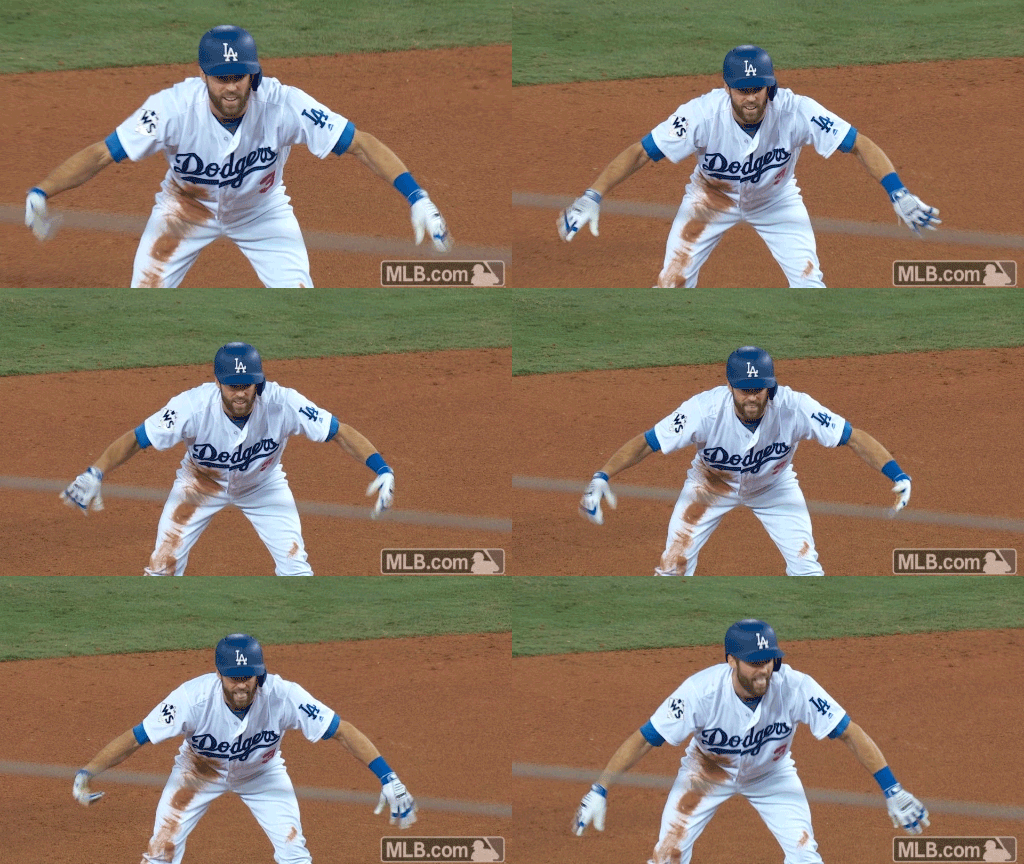
I wish I could. Rarely are we allowed behind the curtain and given an explanation for these things. Thumbs down in 2017 was obvious. The Dodgers have been shaking out their hands after hits for years (GIF) and it started when Chris Taylor had a three-hit game with all jam shots, and Justin Turner shook his hands out to give Taylor a hard time because jam shots sting.
The Yankees this season are doing a circle gesture after hits (GIF via YES Network):

Some guys do it big with both hands like Gleyber Torres there, some guys do it with one finger quickly, but the circle is this year’s hand gesture. I have no idea what it means. Michael Kay speculated it could mean the Yankees are telling each other they have a circular lineup, but I dunno. These things can originate from anywhere and they’re not always family friendly.
(The Yankees had a four-finger hand gesture last year and it was to call out a front office person who wasn’t polite to cafeteria workers in Spring Training.)
Sometimes we get an explanation or the explanation is obvious, and sometimes we’re left in the dark and just have to accept the hand gesture is something for the players and not us. Maybe we’ll get an explanation for the circle at some point. Right now, no one outside the clubhouse knows its meaning.
(Send your requests for Friday's mailbag to RABmailbag at gmail dot com. The random Yankee series is on hiatus, but feel free to send in requests for when it returns.)
High Landers
2022-07-18 13:13:49 +0000 UTCJeff in Canada
2022-07-18 05:03:24 +0000 UTCW.B. Mason Williams
2022-07-17 17:43:10 +0000 UTCYaron P
2022-07-17 00:54:36 +0000 UTCJust a bit outside
2022-07-16 15:31:56 +0000 UTCMikeD
2022-07-15 16:37:18 +0000 UTCChris
2022-07-15 16:14:14 +0000 UTCBig Davey88
2022-07-15 16:08:06 +0000 UTCMichael Axisa
2022-07-15 14:20:22 +0000 UTCJingling Baby
2022-07-15 12:55:51 +0000 UTCJohn
2022-07-15 12:28:47 +0000 UTC