March 9th, 2021: German, Bruce, Luetge, Medina, Hicks, Schmidt
Added 2021-03-09 14:53:36 +0000 UTCAaron Boone had pacemaker surgery Wednesday and was back managing Saturday. Amazing, isn’t it? The Yankees are 4-3 with 24 runs scored and 32 runs allowed this spring (that 15-0 loss to the Phillies last week really skews the run differential). The team leaders have 12 plate appearances (several players tied) and five innings pitched (Jordan Montgomery). This has been your Spring Training statistical update. Here is the updated Grapefruit League television broadcast schedule and here are today’s thoughts.
1. Grapefruit League observations. The Yankees had an off-day yesterday and I am 100% certain Aaron Judge is still hearing about the grand slam Brett Gardner hit Sunday (video). “That'll put some wind in his sails for a couple days as far as the smack talk goes,” Aaron Boone told Bryan Hoch after the game. Let’s get to some scattered Grapefruit League observations.
No. 5 starter competition begins
We finally have a baseball reason to discuss Domingo German. He made his Grapefruit League debut Friday and the results were good (seven up, six down, four strikeouts) against a weak Tigers lineup (it was close to their A-lineup, they’re just really bad). German threw several good changeups and got four misses on seven swings against the pitch (GIF via Dillard Barnhart):

German’s fastball averaged 92.6 mph and topped out at 94.2 mph, which is down from 2019 (93.4 mph and 96.7 mph) and lower than I would’ve expected from a guy who made five winter ball starts, but it’s still plenty enough to get outs. The curveball was not good. It was loopy and had no bite, and German got away with a hanger to JaCoby Jones but not Wilson Ramos (double down the line).
All things considered, it was a good first spring outing for a guy who recently went more than a calendar year between competitive games. Hopefully German builds arm strength and gains feel for the curveball the next few weeks. Otherwise he looked similar to the Domingo German we last saw in 2019, when he threw 143 innings with a 4.03 ERA (4.72 FIP) with 25.8% strikeouts.
“I’ve been satisfied with the work we’ve done,” German told Dan Martin. “Pitching in winter ball gave me the confidence to see I can still compete at a high level. Confidence is big. It put me at ease that I could still compete and find my way back to being the same pitcher I was in 2019.”
Deivi Garcia gave up two solo homers in his Grapefruit League debut last week and was really good aside from those two pitches, getting nine misses on 18 swings, including five on 13 swings against his fastball. My hunch is German is the favorite for the No. 5 starter’s spot and nothing I saw last week leads me to believe the scales are starting to tilt toward Garcia.
Bruce’s hot start
Early “this guy is having a great spring and has to make the team!” candidate: Jay Bruce. He is 4-for-8 with a double and a homer (video), and he made a nice catch in left field that would have been a routine-ish play had the the sun not gotten involved (video). To have any chance at making the MLB roster, Bruce has to hit dingers and catch the ball this spring, and he has so far.
“I know that I’m good enough to be on the roster,” Bruce told Martin. “There’s no question, personally, about that, in my opinion. It goes back to health. Also, a lot of times, it depends on how they want to shape the roster. It depends on what they need from a defensive standpoint and just a player standpoint. So I’m not really concerning myself with a lot of that. If I’m healthy, I’m a good option.”
Bruce has been pretty bad the last three years (92 wRC+ overall and 95 wRC+ against righties with -3 DRS in the outfield) and the timing of everything leads me to believe the Yankees viewed him as a “we need insurance in case Brett Gardner doesn’t come back” signing. Now Gardner is back and the need for a lefty hitting outfielder* is lessened.
* Bruce can also play first, which is nice, but the Yankees have DJ LeMahieu available as the backup at first base. They don’t absolutely need a backup first baseman on the bench the same way they absolutely need a backup shortstop.
Barring injury, the Yankees have an open bench spot alongside Gardner, Kyle Higashioka, and Tyler Wade. They’re not going to overreact to 30-something spring at-bats. They’ll have to really buy into Bruce’s bat bouncing back to carry him over Mike Tauchman, who won’t hit much but will provide a lot more on the bases and in the field (and cost half as much against the luxury tax payroll).
As an Article XX-B free agent (6+ years of service time), Bruce can opt out of his contract if he’s not added to the MLB roster seven days before Opening Day. My guess is the Yankees won’t carry Bruce unless injuries force their hand, and they’ll hope he agrees to go to the alternate site. If not, then I think they’d simply let him opt out, no matter how well he hits in March.
For now, Bruce is doing what he needs to do in camp, and that’s hit and look competent in the field, and say all the right things (that last part was never in question given his reputation). The Gardner re-signing may have closed the door on Bruce as a Yankee, but there are 29 other teams out there, and he could play his way onto one of their rosters.
“A couple more good at-bats (today),” Boone told Martin over the weekend. “(Bruce) continues to look really good here early in camp. I think it’s a product of him being healthy and feeling good, being the hitter he’s been most of his career.”
Luetge’s strikeouts
Lucas Luetge (Lucas Luetge? Lucas Luetge!) is becoming A Thing. The soon-to-be 34-year-old journeyman southpaw has not only struck out eight of the 11 batters he’s faced during Grapefruit League play, he’s also gotten 17 misses on 26 swings (!), which is bonkers any time of year.
Luetge’s fastball has sat right around 90 mph this spring, which is where it was in his previous MLB stints. He’s also thrown -- and has thrown throughout his career -- two distinct breaking balls, so between them and the fastball, he pitches at three different speeds. Luetge has a slow mid-70s curveball and a mid-80s slider (GIFs via Devon Withers and Dillard Barnhart):

It’s been a while since Luetge last pitched in the big leagues (April 2015) and when he did, his breaking ball spin rates were bad to mediocre. Spring Training spin rates aren’t publicly available but I’ve heard Luetge’s are much, much higher now. I don’t know if that’s something he improved on his own while bouncing around Triple-A the last few years, or if the Yankees helped him with it.
UPDATE: Turns out Spring Training Statcast is searchable. Here are Luetge's spin rates, which are indeed up considerably since his last MLB stint in 2015:
- Fastball: 2,770 rpm (2,578 rpm in 2015; 2,306 rpm league average)
- Curveball: 2,866 rpm (2,329 rpm in 2015; 2,532 rpm league average)
- Slider: 2,801 rpm (1,975 rpm in 2015; 2,441 rpm league average)
"I knew we were excited to sign him. He's absolutely jumped out at us going back to even the first bullpens," Aaron Boone told Max Goodman over the weekend. "It's a really good breaking ball, it's a swing-and-miss breaking ball. He's got all the spin numbers that take you back a little bit. Even though he's not overpowering with the fastball, the fastball really plays as well."
The obvious caveat with Luetge’s performance is the competition. He’s pitched in the middle to late innings of Grapefruit League games, so he’s only faced three legitimate MLB hitters (Didi Gregorius, Bryce Harper, Andrew McCutchen) plus one fringe MLB hitter (Tyler White). Every other hitter he’s faced was either a low level minor leaguer or Jeff Mathis.
The good news: Luetge struck out Gregorius, Harper, McCutchen, and White. The bad news: Luetge has faced only 3.5 big league hitters this month. Anytime you put up strikeout numbers like that though, I’m going to take notice. I need to see more before fully buying into the new Luetge, but he’s on my radar because it sounds like he’s tangibly improved his ability to spin the ball. I hope to see him face more actual big leaguers the next few weeks.
Medina’s control issues resurface
Luis Medina’s ostensibly improved control was nowhere to be found during his Grapefruit League debut Friday. Medina walked four of the six batters he faced and threw only 11 of his 28 pitches for strikes. He consistently yanked pitches down and to his gloveside (in on lefties).

The good news is Medina averaged 96.8 mph with his fastball. The bad news is everything else. Medina is going to have days like this the same way Dellin Betances and Aroldis Chapman have days like that. The stuff is great and sometimes he just has no idea where it’s going. I hope we get to see Medina a few more times this spring. Hopefully the good version of Medina.
“I wouldn’t put anything past him because the talent is special," Aaron Boone told Martin last month when asked about Medina making his MLB debut in 2021. “He’s somebody we’re very excited about … You never know what can happen this year. We feel he has a bright future, a Major League future.”
Miscellany
Jameson Taillon struck out four in two scoreless innings in his second Grapefruit League outing over the weekend. He pitched out of a bases loaded jam in the second inning. The game wasn’t televised, so we still haven’t seen him much this spring, but his fastball sat 92.4 mph and topped out at 93.6 mph in that game. That’s about where it was in his first outing last week. So far, so good. “I thought it was good work. There are some things I haven’t experienced in a couple of years, like in-game situations -- runners on, holding runners, mixing my tempo, mixing my looks to second with a runner there. I had to make some pitches with traffic on, so that was probably the biggest takeaway,” Taillon told Bryan Hoch … Gleyber Torres has looked pretty good at shortstop, no? Granted, he’s only had 14 total chances, but he hasn’t made an error and he’s made the routine plays look routine. That was a problem with Gleyber last year. He’d botch routine plays, either with a bobble or a poor throw. No such issues yet this spring, and I’ll take any signs of progress I can get … Giancarlo Stanton has not yet played the outfield but he is hitting missiles. Two 109 mph doubles Sunday, the first on a 93 mph down and in fastball (video). Stanton didn’t even get his arms extended and he hit the ball that hard. I’ve watched an embarrassing amount of baseball in my life and I don’t think I’ve ever seen the ball come off a player’s bat like it does Stanton’s. It’s insane. Please stay healthy, Giancarlo … And finally, Ezequiel Duran (0-for-6 with five strikeouts) and Oswald Peraza (0-for-6 with two strikeouts) look very much like two kids with minimal experience in full season ball (46 Low-A games, all by Peraza) who just lost a season to a pandemic. They’ve been overmatched. Here is Duran’s at-bat against old pal Bryan Mitchell the other day. Poor kid looked like he’d never seen a breaking ball in his life. I can’t imagine Duran and Peraza are the only 20-21 year olds who feel like the game is going a million miles an hour this spring after spending last year at home.
2. Hicks in 2021. Last week Aaron Boone confirmed Aaron Hicks will be the primary No. 3 hitter to begin the regular season. The Yankees love squeezing a lefty bat between Aaron Judge and Giancarlo Stanton, and Hicks is their best (only) regular lefty hitter. Hicks hit third 32 times in 60 regular season games last year, and in all seven postseason games as well.
“I like him third and feel like with his switch-hitting capabilities, his ability to get on base … I kind of envision him in that slot,” Boone told Pete Caldera last week. Assuming everyone stays healthy (fingers crossed), this is the lineup I expect to see against (presumably) Hyun-Jin Ryu on Opening Day:
- 2B DJ LeMahieu
- RF Aaron Judge
- CF Aaron Hicks
- DH Giancarlo Stanton
- 1B Luke Voit
- SS Gleyber Torres
- 3B Gio Urshela
- LF Clint Frazier
- C Gary Sanchez
Hicks had a productive but unusual 2020. He had a .379 OBP with more walks (19.4%) than strikeouts (18.0%), which is objectively great, but he also hit only six home runs in 211 plate appearances (244 if you include the postseason). That’s underwhelming, particularly for a guy who averaged 11 homers per 244 regular season plate appearances from 2017-19.
Of course, Hicks was also Year 1 post-Tommy John surgery, and it’s not unusual for a hitter to have a down year his first year with the new elbow ligament. Didi Gregorius and Corey Seager went through the same thing in 2020 and 2019, respectively. It’s not universal -- Gleyber Torres hit plenty (as an MLB rookie) in his first post-Tommy John surgery year -- but it happens.
“The elbow feels night and day from last year,” Hicks told Kristie Ackert last week. “Talking about the Tommy John, I think extending my right arm (batting) left-handed definitely was making me a little nervous to make full swings. Swinging and missing was definitely a thing I was worried about early on. So I definitely protected it. But as of right now everything feels great.”
Hicks consistently swings at the right pitches. That’s not an issue. More than anything, his problem last year was hitting the ball into the shift as a left-handed hitter. He rolled over on a lot of pitches he should’ve driven in the air. The numbers as a lefty batter:
- 2018: 41.7% grounders and 48.3% pull rate
- 2019: 43.2% and 55.8%
- 2020: 45.7% and 59.1%
Hicks has always pulled the ball quite a bit as a left-handed hitter, which is what you want him to do with the short porch, though his pull rate was extreme last season, and he hit the ball on the ground more often. That made him easy to defend and at least partially explains his batting average on balls in play as a lefty dipping from .282 in 2018 to .258 in 2020.
Being apprehensive when swinging left-handed -- Hicks admitted he was nervous to extend his right arm -- can explain all those rolled over grounders. He wasn’t putting his A-swing on the ball. In theory, this is easy to correct. It’s a mental block more than a physical limitation, and the sort of mental block you can get over with repetition as you get further away from surgery.
Hicks has put three balls in play as a lefty hitter so far this spring and one was a ground out to third base (no video), one was a ground ball single through the shift (video), and one was a routine ground out to second (video). Still pulling the ball on the ground, but it’s also three (3) batted balls, so who knows. It’s only March 9th. We’ll see what happens the next few weeks.
The Yankees led the American League with 5.25 runs per game and a 116 wRC+ last year and that was with Hicks not hitting for power, Torres and Sanchez falling below expectations, and Judge and Stanton missing time with injury. They don’t absolutely need Hicks to hit for power to score a lot of runs, but, if he does, the lineup will approach juggernaut status. I hope to see the pre-Tommy John surgery version of Hicks in Year 2 with his new elbow ligament.
“I definitely see myself hitting 30-plus (homers),” Hicks told Ackert. “That’s what I want to do and that’s what I believe that I can do. If I get 500 plate appearances, I’m definitely going to hit my mark with those numbers. It’s definitely a goal of mine to get 500-plus at-bats and really see what I can do throughout a season, really see what kind of player I am.”
3. Remembering a random Yankee: Claudell Washington. By request, this week’s random Yankee is a player who hit a historic home run in pinstripes, and also hit the foul ball Ferris Bueller caught at Wrigley Field (video). Here's the random Yankee archive. You can find links back to everyone we've covered there.
Washington took an unusual path to the big leagues. He didn’t play high school ball because he wanted to hit and the coach wanted him to pitch, and he went undrafted. The Athletics scouted Washington in sandlot games his senior year and signed him as a 17-year-old undrafted free agent in 1972. They gave him a $3,000 bonus.
Two years later, Washington was in the big leagues. He obliterated the minors (.330/.382/.505 with 26 homers in 215 games) and made his MLB debut with Oakland as a 19-year-old in June 1974. Washington hit .306/.327/.401 in his first 46 big league games and finished 1974 with a .285/.326/.376 batting line. One year later he was an All-Star and received MVP votes.
From 1976-85, Washington was good more than great, authoring a .275/.325/.422 batting line in nearly 5,000 big league plate appearances with the Athletics (1976), Rangers (1977-78), White Sox (1978-80), Mets (1980), and Braves (1981-85). He served a 60-day suspension early in 1986 for his involvement in the Pittsburgh drug scandal.
Atlanta was really bad in 1985 (66-96) and merely mediocre early in 1986. They were 39-36 and two games out on June 30th. The Yankees, meanwhile, were 42-34 on June 30th, though they were eight games out in the division and trending down. From May 30th through June 29th, New York lost 18 times in 29 games and fell out of the AL East race.
Ken Griffey Sr. had been with the Yankees since 1982 and it was no secret he wanted out. He’d openly requested trades for years, and with the Braves in the race and looking to add offense, and the Yankees looking to unload a disgruntled player, the two sides got together for a four-player trade on June 30th, 1986. The full trade:
- Braves get: OF Ken Griffey Sr., IF Andre Robertson
- Yankees get: IF Paul Zuvella, OF Claudell Washington
“I had asked out a long time ago and never got it, but I'm glad it happened. I'm glad it's the National League. It's home,” Griffey told the New York Times after the trade. He played well that year, hitting .308/.351/.503 with 12 homers in 80 games with the Braves, but Atlanta went 33-53 after the trade and fell out of the postseason race. (Robertson spent time with the Yankees from 1981-85 but never played in the big leagues again.)
As for the Yankees, the trade was as much about Zuvella as it was Washington. They had a revolving door at short that year (Dale Berra, Ivan de Jesus, Mike Fischlin, Bobby Meachem) and the 27-year-old Zuvella was having a fine Triple-A season. Alas, he came up, went 4-for-48 (.083) in 21 games as the starting shortstop, and was sent right back to Triple-A.
“Claudell will play in the outfield and Zuvella will play shortstop. Our scouts say Zuvella can play. A couple of our coaches have seen him and like him,” then-manager Lou Piniella told the New York Times after the trade. When asked specifically about Washington’s role, Piniella said: “We just got this guy. Let me think about it.”
Washington, then 31, was a warm body for the Yankees. He hit .270/.336/.460 in 40 games with the Braves and was the fourth outfielder behind Rickey Henderson, Dan Pasqua, and Dave Winfield following the trade. Washington hit .237/.285/.407 with six homers in 54 games with the Yankees, including a 15-for-49 (.306) with four homers in 15 games stretch in July.
Although the 1987 outfield was set -- Henderson, Pasqua, and Winfield were all set to return for another year -- the Yankees quickly re-signed Washington to a one-year deal worth $480,000 in the offseason. Washington was going to serve as a lefty platoon option in the outfield and at DH alongside the starting outfielders and offseason addition Gary Ward.
Despite being on the heavy side of the platoon, Washington started only nine of the first 32 games in 1987. It took a May hot streak (12-for-23 with two homers) and Henderson getting hurt (Henderson later said his hamstring injury was mismanaged) to get Washington into the lineup. He played in 75 of the final 112 games (59 starts) as the most of the time center fielder.
The Yankees went 89-73 and missed the postseason in 1987. Washington hit .279/.336/.420 with nine homers in 339 plate appearances that year, and he was quite a bit better against lefties (.361/.435/.475) than righties (.259/.311/.406), though it was only 69 plate appearances against lefties and the split was inconsistent with the rest of his career.
Roberto Kelly debuted and did well enough in 1987 to get a longer look in center field in 1988. The Yankees again re-signed Washington that offseason -- he received another one-year deal worth $480,000 -- to platoon with Kelly and serve as a veteran caddy. Henderson was in left, Winfield was in right, and the Kelly/Washington platoon would play center.
“I know I have to win the job,” Kelly told Michael Martinez in Spring Training 1988. “I'm not just going to go out there and go through the motions. I've got to prove myself to them day after day. I've got to hustle, which is what Billy likes a lot but is also the way I like to play.”
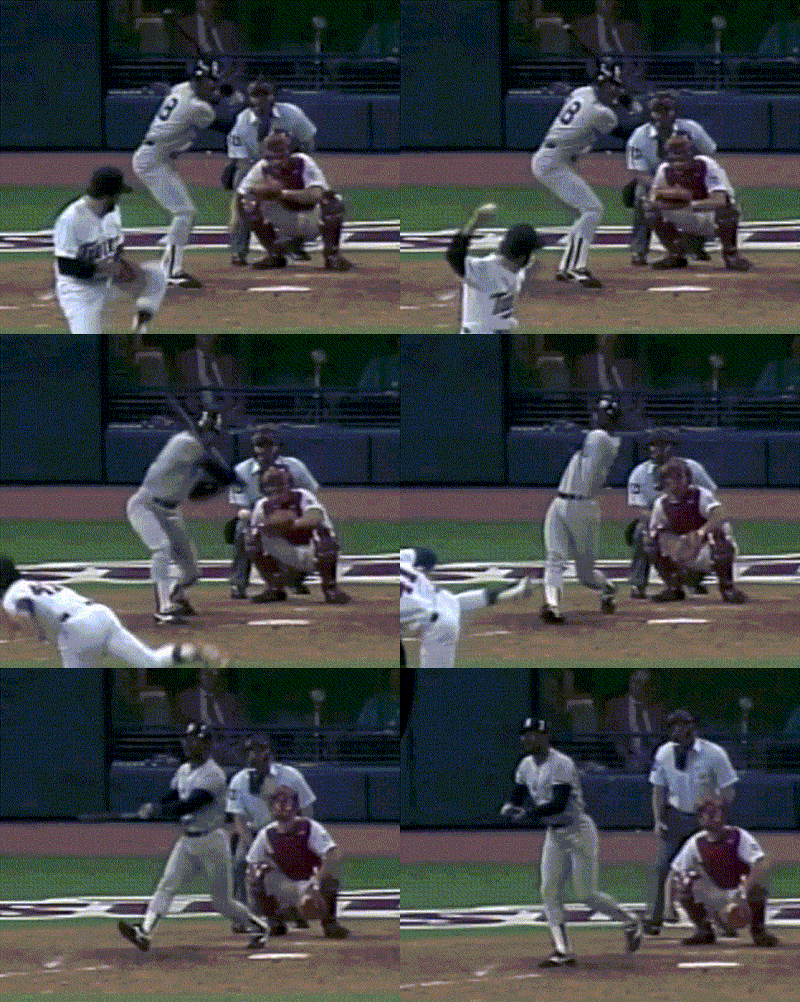
Washington’s signature moment as a Yankee came on April 20th of that season. That night he slugged his 141st career home run against Jeff Reardon at the Metrodome. It broke a 5-5 tie in the top of the ninth, and it was the 10,000th home run in Yankees history. Here’s the video. Please admire Washington’s swing and strut (GIF link):

The Yankees planned to donate the 10,000th home run ball and bat to the Hall of Fame, but Washington kept them. “They want them, but they can’t have them. They can have a replica,” he told Martinez. (The Yankees are up to 16,309 home runs, by the way. The Giants are a distant second with 14,763 homers and the Cubs are third with 14,449 homers.)
Anyway, Kelly started slowly in 1988 (.254/.274/.339 in his first 24 games) and wound up in Triple-A, and Washington settled into a center field platoon with Ward. Washington started 87 of the final 135 team games and hit .331/.346/.440 with nine home runs during that time. He hit .308/.342/.442 overall and his 120 OPS+ was the second best of his career.
The Yankees went 85-76 in 1988 and were in the race into September -- Washington hit an 18th inning walk-off homer against the Tigers on Sept. 11th (video), moving the Yankees into second place in the AL East and 3.5 games behind the Red Sox -- though they faded late, and finished in fifth place in a very tight division (3.5 games separated first and fifth).
“Last year at this point we were out by 10 and fell apart,” Washington told Martinez prior to the final game of the season. “This year, we stayed in there until the end. We may finish in fifth, but it is only four and a half or so out of first place. It doesn't make much difference.”
After the season Washington was one of 14 players declared a “second look” free agent when an arbitrator ruled the owners colluded during the 1986-87 offseason. Those 14 players gained another chance at free agency if they were under contract or had already agreed to a new deal that offseason. (Washington was already a free agent, so he didn’t benefit from the ruling.)
The Yankees moved quickly to sign Andy Hawkins, Dave LaPoint, and Steve Sax after 1988, and they had interest in retaining the then-34-year-old Washington as well. Murray Chass reported the team offered him two years at $750,000 annually, but Washington wanted closer to $900,000 with an option for a third year. The Angels eventually gave him three years at $875,000 a pop.
“It's something I never expected to happen,” Washington’s agent, Tom Reich, told Joseph Durso. ''And I've expressed my regrets to the Yankees. He didn't want to leave New York. If you had asked me in October the chances of his leaving New York, on a scale of 1 to 10, it wouldn't have even been on the scale.”
Bob Quinn, then the Yankees GM, told Durso they “weren't willing to go to three years with a 34-year-old player.” Washington added: “I have nothing negative to say about the Yankee organization. They treated me wonderfully … I wasn't out to get a three-year contract. But it's very important for me and my family, now that I've got one.”
Washington was fine with the Angels in 1989 (.273/.319/.428 with 13 homers in 110 games) and he lasted only 18 team games with the Halos in 1990. They traded him back to the Yankees with Rick Monteleone for Luis Polonia on April 29th. Washington was the fourth outfielder behind Kelly, Mel Hall, and Jesse Barfield. He hit .163/.181/.200 in 83 plate appearances after the trade.
“I'm happy because of one reason: I'm going to play a little bit more,” Washington told Martinez after rejoining the Yankees. “... I love this city, I love the Yankees. I like the Big Apple. I have a lot of fond memories here.”
The Yankees released Washington, then 36, after the 1990 season, and he never played again. He retired as a career .278/.325/.420 (106 OPS+) hitter with 164 home runs in parts of 17 MLB seasons, including .277/.320/.410 (100 OPS+) with 25 homers in 315 games as a Yankee. Washington passed away at age 65 last June, following a long battle with prostate cancer.
4. Rapid fire thoughts. Gerrit Cole was asked about the new baseball over the weekend. He didn’t have anything to say about how lively (or deadened) it is, though he did say it’s easier to grip and more consistent from baseball to baseball. “I haven’t come across anything strikingly weird, which is new. I’m finding them comfortable, I’m finding that the grip is consistent,” he told Sweeny Murti. Too late to let Masahiro Tanaka test his splitter out with the new ball? For what it’s worth, teams were averaging 1.00 home runs per game this spring going into yesterday. Last spring it was 1.13 homers per game before the shutdown (1.28 in the regular season), and in 2019, the year of the dinger, it was 1.21 homers per game in the spring (1.39 in the regular season) … Aaron Boone gave a Clarke Schmidt non-update over the weekend: "As we've checked in with him, it's kind of been better each and every day. But he's still at least another week before he starts throwing. But range of motion, strength, all those things are coming back the way it should, but he's still probably at least a week away from throwing,” Boone told Marly Rivera. Schmidt is two weeks into his 3-4 week shutdown, and once he’s cleared to throw, he’ll essentially have to go through Spring Training. Figure he’ll be an MLB option in late April or May as long as there are no setbacks … And finally, Evan Drellich (subs. req’d) reports the revenue sharing system will return in 2021 (revenue sharing was suspended last year), but with a twist. The 2021 payments will be spread across 2021-22, and MLB is taking out a loan to cover the 2021 portion, which will then be repaid by revenue sharing payers (big market teams like the Yankees). Here’s how that’s going *grabs popcorn*:
“They can say whatever they want for politics, the understanding is it’ll never be paid back,” the executive (with a big market team) said.
The commissioner’s office disagrees. “That’s absolutely false,” a league source said. “The presumption is that the money will be paid back.”
Fortunately, this is not an MLB vs. MLBPA labor issue. This is a big market teams vs. MLB and small market teams issue. Anyway, Drellich also notes the Yankees are no longer the top revenue sharing payer. It’s the Dodgers. The Yankees aren’t even second. They were fourth behind the Dodgers, Red Sox, and Cubs in 2019. The Yankees get to subtract Yankee Stadium debt payments from the revenue sharing calculation and it knocked their payment down to $60M in 2019. This stuff fluctuates from year to year, but Randy Levine said the Yankees paid $90M in revenue sharing in 2015, so either the Yankees saw a fairly significant revenue loss from 2015 to 2019 (nope) or Levine overstated their revenue sharing payment back in 2015 (yup).
(Send your requests for Tuesday's random Yankee series and questions for Friday's mailbag to RABmailbag at gmail dot com.)
Comments
...and if Luetge makes the team and continues to pitch well, there will likely either be another injury, or someone just not pitching up to par by the time Britton returns. We should dream of a world where we have too many quality arms in the pen!
MikeD
2021-03-12 16:42:01 +0000 UTCI had the same thought. The loss of Britton certainly means that there is a far higher likelihood that Luetge makes the team (if he continues to perform). It helps that he is potentially expendable when Britton returns (so Britton opens a 40 man slot going on the IL, and then needs a cut later when he returns).
DZB
2021-03-10 11:45:15 +0000 UTCWell, Luetge's chances of making the team just got a boost with Britton's surgery. The obligatory: Getting Severino and Britton back come July will be like making a huge trade! Beyond that, losing a quality arm for half a season is not a good thing, particularly this year when teams are seeking arms to eat innings coming off the shortened pandemic season of 2020.
MikeD
2021-03-10 05:12:25 +0000 UTCThat's my contention too. Not just about the Yankees, but "true" power hitters in general. Their value will increase because they won't be impacted by the deader ball and their skillset will be more valued as the medium-range power hitters will hit few homers.
MikeD
2021-03-10 05:09:18 +0000 UTCMan, it sucks we won’t be able to see Tanaka’s splitter with the better seams.
Vismay Pandia
2021-03-09 17:39:57 +0000 UTCIndeed. I assume this is a reference to Britton. His absence would be really painful, even with a decent collection of relievers. He offers a really different look to hitters and has been so reliable.
DZB
2021-03-09 16:20:39 +0000 UTCGood morning, I would like it if Yankee players could stop getting familiar with stupid MRI machines. Thank you and good day.
Big Davey88
2021-03-09 15:45:36 +0000 UTCI think a deader ball would be good for the NYY. This is a team that can smash HRs way past the minimum needed (especially Judge, Stanton, Sanchez, Voit), so I would rather see mediocre hitters from other teams struggle to clear the fence while those insane shots just become sane.
DZB
2021-03-09 15:33:26 +0000 UTC